Wise: Howdy, Werth. Have a piece of cake!
Werth: Is it already birthday time again at Film Gab? No wonder I can't fit into my Z. Cavaricci jeans.
 Wise: Quit your bellyaching and put on these tap shoes. It's Ann Miller's birthday.
Werth: Why didn't you say so in the first place? Make it a big piece of cake and I'll break out my dancing fan.
Wise: Just be sure to leave some room for soup.
Werth: All that's missing from that number is a giant saltine.
 Wise: Miller's career really took off in the late 40's when she landed at MGM. Her tough girl style and gorgeous gams injected a jolt of electricity into the sumptuous musicals produced by Arthur Freed, but few films take as full advantage of her talents as On the Town (1949). The film follows three sailors on shore leave—Gene Kelly as Gabey, Frank Sinatra as Chip, and Jules Munshin as Ozzie—as they sing, dance and find sweethearts while exploring New York City.
Miller plays Claire, an anthropologist with a penchant for prehistoric man, who eventually falls for Ozzie, while Chips falls for Hildy (Betty Garrett) and Gabey falls for the elusive Miss Turnstiles, Ivy Smith (Vera-Ellen). This was the first movie that Gene Kelly co-directed with Stanley Donen, and his signature, muscular style of dancing infuses the film with the kind of aggressive exuberance that was so much a part of his persona.
Werth: You say aggressive exuberance, I say unrelenting ham.
 Wise: At Kelly's insistence, a fair amount of the film was shot on location in New York—most notably the American Museum of Natural History, Rockefeller Center, the Statue of Liberty, and the Brooklyn Bridge—instead of recreating those landmarks in the studio, and, surprisingly, the juxtaposition of the real and the manufactured works incredibly well.
Cinematographer Harold Rossen makes the city look like a picture postcard, transforming the streets and avenues into a fantasy landscape that blends seamlessly with the Hollywood sets.
Werth: The one downside of shooting on location was the crowd of screaming fans that showed-up wherever Sinatra appeared.
 Wise: The screenplay by Betty Comden and Adolph Green is full of zest and wit while highlighting each member of the leading sextet. Sinatra shares a duet with Betty Garrett that manages to be both funny and touching, and Kelly leads Vera-Ellen in one of the dream ballets that were rapidly becoming part of his movie signature.
But it's Ann Miller who steals scene after scene, not just with her top notch dancing skills, but with the incredible force of her personality as it bursts from the screen.
Werth: Before Miller was known for tap-dancing her way through scenery, she appeared in 1938's Best Picture Oscar-winner, You Can't Take It with You. Based on the Pulitzer prize-winning George S. Kaufman play of the same name, You Can't stars Jean Arthur as Alice Sycamore, a secretary who has a yen for her young boss, Tony Kirby (a pre-Mr. Smith James Stewart.) Their romance is running hot and heavy until Tony tries to introduce his upper-crust mother and father to Alice's bohemian family.
Wise: This is beginning to sound like the plot to a Goldie Hawn and Kurt Russell flick.
 Werth: Besides the fact that the Sycamore clan is a bunch of artistic, anarchist goofballs led by the folksy Grandpa Vanderhof (a usually seated Lionel Barrymore), their home is the last holdout on the block that Tony's dad (Edward Arnold) is attempting to buy out before demolishing it to make way for his new munitions plant.
This makes for an uncomfortable dinner, made even more uncomfortable by sister Essie's (Miller) clumsy attempts at ballet in the living room. According to her teacher, Kolenkhov, "Confidentially, it steenks."
Wise: I'm sure Ann Miller mostly smelled of Jean Naté and shoe polish.
 Werth: Social stratum collide in a courtroom and love has to find a way to overcome the gap between the haves and the have-nots all while Essie twirls and falls on the carpet. The little man versus corporate greed story was one that director Frank Capra made his stock in trade.
He'd already won two Oscars for Best Director (It Happened One Night (1934) and Mr. Deeds Goes to Town (1936), and the Academy would add another one to his mantle for You Can't. Capra had a knack for kooky characters, like the denizens of the Sycamore home, and created supportive, tough communities on screen that resembled his ideal of America.
You Can't isn't as compelling as Mr. Deeds, Mr. Smith Goes to Washington (1939), Meet John Doe (1941), or It's a Wonderful Life (1946), partly because it feels preachy in a way that those other films don't. But it's still a great example of the successful post-Depression/pre-WWII films that gave cinematic voice to the political struggle going on in America, all while audiences munched away on their popcorn.
Wise: And on that note, I think I'll try to hunt down a video of Ann Miller with Mickey Rooney in Sugar Babies.
Werth: You're welcome. Tune-in next week for more fancy footwork here at Film Gab.
Werth: Howdy, Wise. It looks like you're all ready for the opening of Oz The Great and Powerful.
Wise: I sure am. I've got my 3-D glasses, my official Glinda wand, my James Franco doll, and even a bucket in case the whole thing turns my stomach.
Werth: But where are your Ruby Slippers?
Wise: Well, as the endless barrage of puff pieces in the press will tell you, the Ruby Slippers belong to Warner Bros., the current owner of MGM's The Wizard of Oz, and won't turn up in Sam Raimi's film which is supposed to be based on ideas culled from L. Frank Baum's original 14 Oz books. But rabid Oz fans needn't fret if they're looking for direct ties to the Judy Garland movie because the talented artisans who worked at Metro Goldwyn Mayer left traces of their handiwork all over scores of great films.
Not only can you see Margaret O'Brien carrying Dorothy's basket in Little Women (1949), Janet Gaynor decked out in Glinda's gown in San Francisco (1936), you can also check out what looks suspiciously like Dorothy's front door in a gangster's apartment in Another Thin Man (1939).
Werth: Not only did props, costumes and set pieces from The Wizard of Oz make their way into other movies, the director Victor Fleming can be found directing oodles of other classic films. In fact, 1939 was a good year for Fleming as he directed both The Wizard of Oz and Gone With the Wind and even won the Best Director prize for the latter. But Fleming was a successful director years before he went to the merry old land of Oz.
When he directed the show business comedy Bombshell in 1933, he was already one of Hollywood's top directors. Teamed again with his Red Dust (1932) leading lady Jean Harlow, Fleming opens Bombshell with a whirlwind montage of Lola Burns: movie star, fashion icon, tabloid cutie and perfume purveyor.
Wise: This was long before most celebrity fragrances stank.
Werth: It's actually kind of amazing how topical this 80 year old movie is. Lola feels trapped by her stardom which includes mobs of autograph seeking fans, stalkers, opportunistic salesmen, and a family of money-hungry vultures—led by her tippling, buttinsky father Pops, played by the Wizard himself, Frank Morgan.
Wise: He didn't spend all his leisure time driving around a Technicolor horse.
Werth: And the man who gives her the most grief is the studio's press agent Space "Bud" Hanlon (Lee Tracy) who places made-up, salacious news stories about Lola on the front page every chance he gets. Of course this doesn't stop the two of them from getting a yen for each other. Bombshell is like a loud, shouting roller coaster ride.
The dialogue is lightning quick with the insults and one-liners flying at a rat-a-tat pace. Frankly, by the time Lola attmepts to escape Hollywood by running away to a desert resort, the audience feels like it needs to join her for a well-earned rest. But Bombshell is a heck of a lot of fun, and even though she isn't as comically smooth as she was in Red Dust or Dinner at Eight (1933), watching Harlow is always a treat. That platinum mop of hair and her wise-cracking, luminous face light up the screen in a way that few stars can.
Wise: Stars who light up the silver screen are blessed with luck, talent as well as an army of off-screen artists who are able to create that Hollywood glow. And perhaps no one had as large and as lasting and impact on the way Hollywood looked as Sydney Guilaroff, the legendary hair stylist to the stars. Discovered by Claudette Colbert and championed by Joan Crawford, Guilaroff became the chief stylist at MGM and worked his magic in over a thousand films.
He designed signature looks for Katherine Hepburn in The Philadelphia Story (1940), Marilyn Monroe in Some Like it Hot (1959), for Liza Minnelli in New York, New York (1976), and had a huge impact on The Wizard of Oz by creating Judy Garland's iconic braids.
Werth: He also kept Joan Crawford company when she won the Oscar for Mildred Pierce... in her sickbed.
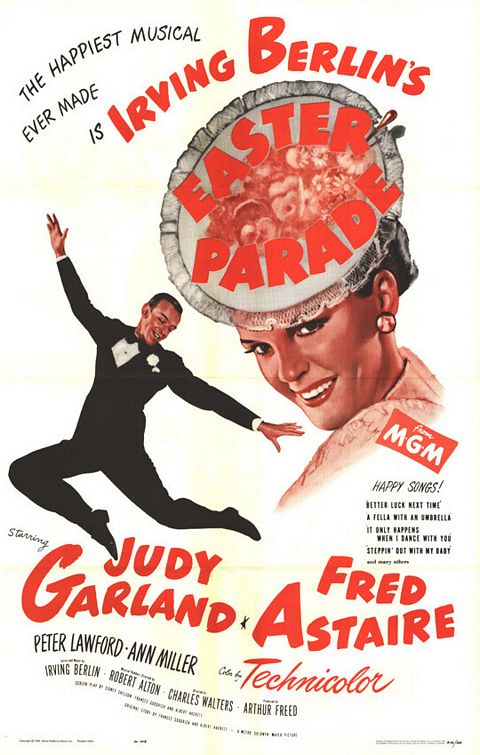
Wise: Guilaroff not only made certain that stars looked good, he also helped them create their characters for the screen, and some of his most interesting work resulted when he re-teamed with Garland in Easter Parade (1948). The film follows Don Hewes (Fred Astaire) who is unceremoniously dumped by his dance partner Nadine Hale (Ann Miller) when she is offered a solo in the Ziegfeld Follies. Furious, Don resolves to transform the next women he meets into a replacement for Nadine.
When that woman turns out to be a very unlikely Hannah Brown (Garland), he at first tries to re-do her in Nadine's glamorous image before realizing Hannah's true worth both on- and off-stage, and eventually the two fall in love, all set to Irving Berlin's magical score.
Werth: Judy and Ann starred in lots of projects together, including an episode of Hollywood Hoarder.
Wise: Easter Parade presented a series of challenges to Guilaroff who had to design styles that not only reflected the film's 1912 setting but also Hannah's gradual evolution from frumpy chorus girl to star. Garland begins the picture with tightly wound curls, then switches to an imitation of Miller's slicked and elegant coif, before her hair gradually becomes softer and more natural for the finale.
Along the way she famously dons a short, ratty wig as she and Astaire perform the film's most famous number, "A Couple of Swells," costumed as tramps. It's subtle work, but it's also a reminder of all the myriad talents that go into making a picture great.
Werth: If the box office buzz is any indication, the myriad of talents who worked on Oz The Great and Powerful, will have cause to celebrate.
Wise: We'll celebrate next week with another installment of Film Gab!
 Wise: Quit your bellyaching and put on these tap shoes. It's Ann Miller's birthday.
 Wise: Miller's career really took off in the late 40's when she landed at MGM. Her tough girl style and gorgeous gams injected a jolt of electricity into the sumptuous musicals produced by Arthur Freed, but few films take as full advantage of her talents as On the Town (1949). The film follows three sailors on shore leave—Gene Kelly as Gabey, Frank Sinatra as Chip, and Jules Munshin as Ozzie—as they sing, dance and find sweethearts while exploring New York City.

 Wise: At Kelly's insistence, a fair amount of the film was shot on location in New York—most notably the American Museum of Natural History, Rockefeller Center, the Statue of Liberty, and the Brooklyn Bridge—instead of recreating those landmarks in the studio, and, surprisingly, the juxtaposition of the real and the manufactured works incredibly well.

 Wise: The screenplay by Betty Comden and Adolph Green is full of zest and wit while highlighting each member of the leading sextet. Sinatra shares a duet with Betty Garrett that manages to be both funny and touching, and Kelly leads Vera-Ellen in one of the dream ballets that were rapidly becoming part of his movie signature.


 Werth: Besides the fact that the Sycamore clan is a bunch of artistic, anarchist goofballs led by the folksy Grandpa Vanderhof (a usually seated Lionel Barrymore), their home is the last holdout on the block that Tony's dad (Edward Arnold) is attempting to buy out before demolishing it to make way for his new munitions plant.

 Werth: Social stratum collide in a courtroom and love has to find a way to overcome the gap between the haves and the have-nots all while Essie twirls and falls on the carpet. The little man versus corporate greed story was one that director Frank Capra made his stock in trade.