Showing posts with label Jean Harlow. Show all posts

Friday, March 8, 2013

We're Off to Gab the Wizard

Werth: Howdy, Wise.  It looks like you're all ready for the opening of Oz The Great and Powerful.  

Wise: I sure am.  I've got my 3-D glasses, my official Glinda wand, my James Franco doll, and even a bucket in case the whole thing turns my stomach.  

Werth: But where are your Ruby Slippers?

Wise: Well, as the endless barrage of puff pieces in the press will tell you, the Ruby Slippers belong to Warner Bros., the current owner of MGM's The Wizard of Oz, and won't turn up in Sam Raimi's film which is supposed to be based on ideas culled from L. Frank Baum's original 14 Oz books.  But rabid Oz fans needn't fret if they're looking for direct ties to the Judy Garland movie because the talented artisans who worked at Metro Goldwyn Mayer left traces of their handiwork all over scores of great films.  
Not only can you see Margaret O'Brien carrying Dorothy's basket in Little Women (1949), Janet Gaynor decked out in Glinda's gown in San Francisco (1936), you can also check out what looks suspiciously like Dorothy's front door in a gangster's apartment in Another Thin Man (1939).

Werth: Not only did props, costumes and set pieces from The Wizard of Oz make their way into other movies, the director Victor Fleming can be found directing oodles of other classic films. In fact, 1939 was a good year for Fleming as he directed both The Wizard of Oz and Gone With the Wind and even won the Best Director prize for the latter. But Fleming was a successful director years before he went to the merry old land of Oz. 
When he directed the show business comedy Bombshell in 1933, he was already one of Hollywood's top directors. Teamed again with his Red Dust (1932) leading lady Jean Harlow, Fleming opens Bombshell with a whirlwind montage of Lola Burns: movie star, fashion icon, tabloid cutie and perfume purveyor.


Wise: This was long before most celebrity fragrances stank. 

Werth: It's actually kind of amazing how topical this 80 year old movie is. Lola feels trapped by her stardom which includes mobs of autograph seeking fans, stalkers, opportunistic salesmen, and a family of money-hungry vultures—led by her tippling, buttinsky father Pops, played by the Wizard himself, Frank Morgan.

Wise: He didn't spend all his leisure time driving around a Technicolor horse. 

Werth: And the man who gives her the most grief is the studio's press agent Space "Bud" Hanlon (Lee Tracy) who places made-up, salacious news stories about Lola on the front page every chance he gets. Of course this doesn't stop the two of them from getting a yen for each other.  Bombshell is like a loud, shouting roller coaster ride. 
The dialogue is lightning quick with the insults and one-liners flying at a rat-a-tat pace. Frankly, by the time Lola attmepts to escape Hollywood by running away to a desert resort, the audience feels like it needs to join her for a well-earned rest. But Bombshell is a heck of a lot of fun, and even though she isn't as comically smooth as she was in Red Dust or Dinner at Eight (1933), watching Harlow is always a treat. That platinum mop of hair and her wise-cracking, luminous face light up the screen in a way that few stars can.


Wise: Stars who light up the silver screen are blessed with luck, talent as well as an army of off-screen artists who are able to create that Hollywood glow.  And perhaps no one had as large and as lasting and impact on the way Hollywood looked as Sydney Guilaroff, the legendary hair stylist to the stars.  Discovered by Claudette Colbert and championed by Joan Crawford, Guilaroff became the chief stylist at MGM and worked his magic in over a thousand films.  
He designed signature looks for Katherine Hepburn in The Philadelphia Story (1940), Marilyn Monroe in Some Like it Hot (1959), for Liza Minnelli in New York, New York (1976), and had a huge impact on The Wizard of Oz by creating Judy Garland's iconic braids. 

Werth: He also kept Joan Crawford company when she won the Oscar for Mildred Pierce... in her sickbed.
 
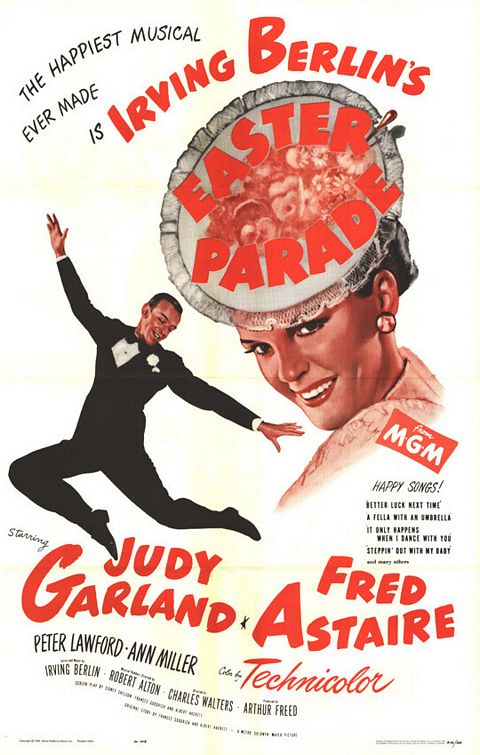
Wise: Guilaroff not only made certain that stars looked good, he also helped them create their characters for the screen, and some of his most interesting work resulted when he re-teamed with Garland in Easter Parade (1948).  The film follows Don Hewes (Fred Astaire) who is unceremoniously dumped by his dance partner Nadine Hale (Ann Miller) when she is offered a solo in the Ziegfeld Follies.  Furious, Don resolves to transform the next women he meets into a replacement for Nadine.  
When that woman turns out to be a very unlikely Hannah Brown (Garland), he at first tries to re-do her in Nadine's glamorous image before realizing Hannah's true worth both on- and off-stage, and eventually the two fall in love, all set to Irving Berlin's magical score.  

Werth: Judy and Ann starred in lots of projects together, including an episode of Hollywood Hoarder.


Wise: Easter Parade presented a series of challenges to Guilaroff who had to design styles that not only reflected the film's 1912 setting but also Hannah's gradual evolution from frumpy chorus girl to star.  Garland begins the picture with tightly wound curls, then switches to an imitation of Miller's slicked and elegant coif, before her hair gradually becomes softer and more natural for the finale.  
Along the way she famously dons a short, ratty wig as she and Astaire perform the film's most famous number, "A Couple of Swells," costumed as tramps.  It's subtle work, but it's also a reminder of all the myriad talents that go into making a picture great. 

Werth: If the box office buzz is any indication, the myriad of talents who worked on Oz The Great and Powerful, will have cause to celebrate.


Wise: We'll celebrate next week with another installment of Film Gab!  


Friday, February 8, 2013

The Naughtiest Year Ever!

Film Forum is tipping its hat to the "naughtiest" year in Hollywood with a 4 week film festival. 1933 was the last year that Hollywood ignored the infamous Production Code, so many of the films contain blushable moments, sharp dialogue and controversial topics from rape, prostitution and suicide to the length of a gal's skirt.
Check out gems like Gold Diggers of 1933, Dinner at Eight, Bombshell, Baby Face, Footlight Parade, Duck Soup, She Done Him Wrong, The Story of Temple Drake, Dancing Lady, and I Cover the Waterfront.
On Monday, February 18th, Film Forum is giving an extra special Pre-Code treat with a reading of the notrious film Convention City, which is unfortunately a lost film.


It's a festival only Joseph I. Breen couldn't love.

Friday, July 22, 2011

Dear Mr. Gab-le...

Wise: Happy Friday, Werth!

Werth: Frankly, my dear, I don't give a damn!

Wise: Someone's still on a Clark Gable high after seeing The Misfits last Sunday.

Werth: All Hail the King!

Wise: Even at nearly twice his co-star's age, Gable still exudes a magnetic sex-appeal that makes him a formidable match to Monroe's golden goddess routine.

Werth: Gable always had a way with the ladies. To quote his co-star and on-and-off lover Joan Crawford, Gable had "balls." Gable's matinee idol looks and masculine performances were so recognizable and influential that it's hard to imagine old Hollywood without him. One of his early films, 1932's Red Dust contains the cinematic recipe for Gable's long and successful career, and coincidentally is being shown at Film Forum August 5th. After being paired a year earlier with Greta Garbo (Susan Lenox: Her Rise and Fall) and Crawford (Possessed), MGM cast Gable with one of their biggest female stars, Jean Harlow. The combination of these two irresistible smart-asses was electric. In Red Dust Gable plays Dennis Carson, the owner of a rubber plantation in the armpit of Indochina.

Wise: It's certainly no Tara. 

Werth: When Vantine (Harlow), a platinum-blond, wise-cracking floozy on the run, winds up on his front step, Gable does what any red-blooded rubber plantation owner would do—

Wise: Rubber?  He hardly knows her. 

Werth: But their budding romance is interrupted by the arrival of a new manager (Gene Raymond) and his wife (the masterful Mary Astor.) 
Astor's icy prim and proper act is like cheese to Gable's rat, so when a conveniently-timed monsoon soaks them both, Gable can't help but take a big, wet bite. Soon he is busy juggling these two personifications of the Madonna-Whore Complex, a jealous husband, and a failing rubber crop.

Wise: That's a lot of balls in the air. 

Werth: Directed by the also man-ly Victor Fleming, Red Dust crackles with adventure, sex and wit. Gable cemented the screen persona that would stay with him most of his career- the lovable cad who can tromp through the jungle one minute and make sweet love to a woman the next. And Harlow is Gable's perfect foil, unable to resist him at the same time she's telling him to get lost. 
Her famous pre-Code water barrel scene gave the Catholic League conniption fits and is as fresh and flirty today as it was in 1932. For those who enjoy their Asian stereotypes turned up to 11, don't miss Willie Fung as the houseboy you wish you could understand.

Wise: Asian houseboys aside, part of what makes Gable so entertaining to watch is the humor he uses to leaven his rugged persona, and nowhere is his wit on better display than in It Happened One Night (1934).  Directed by Frank Capra, the film helped to set the pattern for the screwball comedies that would come to define the era.  Spoiled socialite Ellie Andrews (Claudette Colbert) is kidnapped by her father (Walter Connolly) in an attempt to prevent her from marrying a fortune-hunting playboy.  

Werth: Similar to what's keeping me apart from Prince Harry.  

Wise: Escaping from her father's yacht, she is discovered by Peter Warne (Gable), a recently fired reporter who forces her to choose between giving him the exclusive story on her rebellion or contacting her father and collecting the reward.  
Reluctantly, Ellie agrees to the former and the two set off cross-country to deliver her back to her shiftless sweetheart in New York.  After a series of misadventures (including bus rides, doughnut dunking, haystack sleeping and a very famous scene where Ellie uses her gams to hitch a ride with Alan Hale), the two fall in love only to be separated by a misunderstanding at the last minute.  

Werth: Again, just like me and Harry.

Wise: Luckily this is Hollywood and they're reunited before the final fadeout.  It Happened One Night was the first movie to win all five top awards at the Oscars, and was the only picture to have done so until it was joined by One Flew Over the Cuckoo's Nest and Silence of the Lambs.  It is also one of the most beloved films of old Hollywood with the requisite legends (Gable's fast-talking scene with a carrot inspired Bugs Bunny)—

Werth: Not to mention the cinema legend that the sight of a shirtless Gable made the sales of men's undershirts plummet.

Wise: —and homages (in everything from Grey's Anatomy to Spaceballs).   

Werth: It's great to see Gable appreciated by new generations of moviegoers.  

Wise: Those moviegoers should check in next week and appreciate another edition of Film Gab.

Werth: Now that's something I can give a damn about.