Wise: Zzzzzzz...
Werth: Wake up, Wise. It's time for Gab.
Wise: Sorry, work has been crazy and with the holiday season in full swing, I've been running myself ragged.
Werth: You should relax. Make yourself a hot chocolate and curl up with an old favorite book.
Wise: I tried that. But I just nodded off.
Wise: Then maybe you should watch a favorite old book movie like The Hobbit which opens in theaters today. When I was a kid, Tolkien's book was all the rage and became a big screen cartoon starring the voices of John Huston, Otto Preminger, and Hans Conreid.
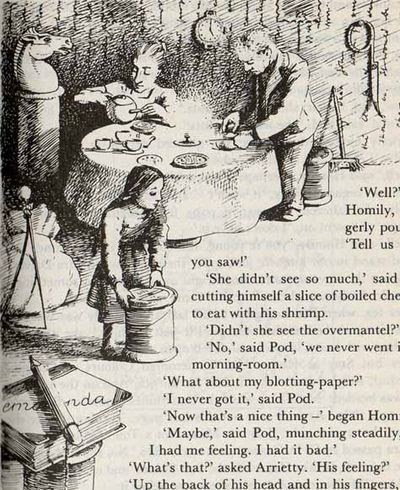
Wise: Popular childhood books always seem to make their way to the big screen. Published in 1952, Mary Norton's The Borrowers became an instant hit both in Great Britain and in the U.S. The book features Arrietty, the adolescent daughter of Pod and Homily Clock, and her struggles as part of a tiny race of people known as Borrowers who live inside the walls of houses and make their living by "borrowing" from human "beans." Their home is behind a hall clock inside an estate deep in the country, populated only by bedridden old Great Aunt Sophy and a cantankerous housekeeper and gardener.

Arrietty longs for companionship—the house is empty of little people except for her family—and she strikes up a tentative friendship with a human boy who has been sent to his great aunt in the country to recuperate from an illness. Eventually, their friendship is discovered by her parents who insist she give it up and by Mrs. Driver, the cook, who enlists an exterminator to take care of what she thinks of as "vermin."
Werth: I wish she would take care of my downstairs neighbor.
 Wise: In the end, the Clocks must abandon their home and flee across the fields in hopes of finding other Borrowers who emigrated years before. It's something of a melancholy end to a book about loneliness, displacement and fear of the unknown. The book's cliffhanger ending inspired four sequels and at least a half dozen film adaptations, each of which is more or less enjoyable, although none equal the original in emotional heft. The book shares with a lot of other juvenile British classic a concern with the isolation of childhood and the fear of parental abandonment. The films are mostly about special effects.
Werth: Yeah, The Borrowers doesn't exactly lend itself to cinematic realism.
 Wise: One of the earliest adaptations premiered in 1973 and starred Eddie Albert as Pod and Film Gab favorite Judith Anderson as a very tipsy Aunty Sophy. Largely faithful to the book, the film suffers from an overly stately pace plus an expansion of the adult roles that leads to a lot of preening overacting by Albert that relegates Arrietty's longings to a subplot.
Perhaps it's just as well because Canadian child actor Karen Pearson seems to have been cast more for her resemblance to Arrietty in Beth and Joe Krush's illustrations than for her acting ability. Dennis Larson as the boy she befriends is even less compelling, although to be fair, both youngsters shared most of their scenes with a green screen instead of another actor.
Werth: Judging from their IMDb movie resumes, I don't think we can blame the green screen.
Wise: The 1997 Borrowers may be much less faithful, but it is filled with eye-popping special effects. Exchanging Norton's late-Victorian setting for a storybook version of post-WWII England filled with late 20th century American product placements, the film is obviously attempting to capture the gross-out humor/kid revenge vibe of the Home Alone films. John Goodman stars as Ocious P. Potter, a nasty lawyer invented for the film who is attempting to swindle away the house of the hapless Lender family.
Arrietty (Flora Newbigin) is joined by her screenwriter-invented younger brother Peagreen (a whiny Tom Felton before he went platinum and menaced a more famous Potter), and together they attempt to stop the villain with a lot of bathroom jokes and booby traps that tend to splatter. Luckily, in this version Pod is played by Jim Broadbent who brings eager nobility and daft humor to help save the day.
Werth: Jim Broadbent's daft humor always saves the day.
Wise: There is also an adaptation written by animation genius Hayao Miyazaki for his Studio Ghibli that I haven't yet seen, although I've heard that it may come closest to capturing Norton's classic tale.
Werth: While you're Netflixing that, some of my favorite books to read when I was a kid were about the ancient Greek myths. Like super-hero soap operas from antiquity the stories of the Greek gods were a constant source of drama, lust and gore. And in 1981 director Desmond Davis brought all that fun to the big screen in Clash of the Titans. Clash tells the tale of Perseus, who starts off life being chucked in the ocean in a box with his mother because she had a baby out of wedlock.
Wise: Wow. I would think the ocean would have been full of boxes with babies and mamas.
Werth: Luckily for Perseus, the baby daddy is none other than king of the gods, Zeus (none other than king of the actors, Laurence Olivier). Zeus saves the boy and his mother and Perseus grows to be a strapping, bare-chested, pillow-lipped Harry Hamlin.
Wise: Pillow-lips seem to run in that family.
Werth: The plot of Clash, like the Greek myths it borrowed loosely from, becomes very complicated with Perseus' quest to save the beautiful Andromeda (Judi Bowker) taking him all over Greece. Perseus tracks down Stygian witches, battles Medusa, jousts with giant scorpions and faces off with the Kraken.
All this while a menagerie of gods bicker and vengeful ass-face Calibos (Neil McCarthy) does his best to kill the mighty hero. It's all great fun with a wonderfully campy crew playing Greeks and Olympians including Olivier, Maggie Smith, Ursula Andress (they gave her one line), Sian Phillips and Burgess Meredith playing the Greek version of Mickey Goldmill.
Wise: Better Mickey than the Penguin.
Werth: But the real star of this film is legendary special effects god, Ray Harryhausen. Using good, old-fashioned stop-motion puppetry, blue-screens, and matte painting, Harryhausen brought all the fantastical creatures from myth to life, and while none of them
look realistic by today's CGI-obsessed standards, Harryhausen's pets were good enough to strike terror into kids' hearts everywhere—especially a certain kid whose worst ophidiaphobe nightmare is a snake chick who has more snakes for hair.
Wise: I'm surprised you survived your initial viewing.
Werth: Harry Hamlin's gams kept my eyes off Medusa. Clash earned a bucketload for MGM and was even resurrected in 2010 for a more tech-savvy audience. It is one of those films that holds a revered place in my heart, because whenever I see it, I'll always be the myth-obsessed nine-year-old who wondered what it was like to be a hero... or a lady with snake hair.
Wise: Well Werth, I'm officially relaxed.
Werth: Good, but don't get too relaxed. You have to be ready next week for Film Gab's Christmas Spectacular!
Wise: Good day, Werth.
Werth: Good day, Wise. Have you finished signing our birthday card to Hillary Clinton?
Wise: I got distracted by one of those memes of her texting in sunglasses.
Werth: I really enjoy watching her strut through press conferences in her power pantsuits. But then I've always found women in politics exciting—especially if they are women in politics in the movies!
Take the role of Eleanor Shaw Iselin (Angela Lansbury) in the 1962 political thriller, The Manchurian Candidate. Eleanor's son Raymond (Laurence Harvey) has just returned from being a prisoner of war in Korea and she immediately turns his Medal of Honor arrival into a band-playing, banner-waving photo op for her husband, the McCarthy-esque Senator, John Iselin (James Gregory).
Wise: Wouldn't a pot roast have been easier?
Werth: Eleanor's political ambitions to be the wife of a Vice-President know no bounds and include trying to keep her son away from a left-wing politician's daughter who Raymond takes a fancy to.
But Raymond is acting very strangely and some of the men from his company have started having nightmares where they are having tea in a New Jersey garden club with the top brass of the Soviet and Chinese Communist Party who turn into little old ladies who tell Raymond to kill his own men.
Wise: That sounds like Bayonne to me.
Werth: Major Bennett Marco (Frank Sinatra—who also produced) begins to investigate and soon discovers that he and his patrol are cards in a deadly game of solitaire. John Frankenheimer's taut direction and iconic visual punch make this film one of the great suspense classics of all time.
All the performances are first-rate—but Lansbury dominates this film. Her portrayal of Eleanor as a woman whose naked ambition is lightly clothed in good ol' American maternal sentiment as she icily barks orders at her son, her husband and anyone who stands in her way should have won the Best Supporting Actress Oscar that year. Patty Duke walked away with it for The Miracle Worker, but I've always felt that Landsbury was robbed... even if it was by Helen Keller.
Wise: The Young Victoria (2009) charts the political and personal growth of Queen Victoria (Emily Blunt) in the years just previous to and just following her ascension to the throne. Growing up sheltered by her mother The Duchess of Kent (Miranda Richardson) and her mother's adviser Sir John Conroy (Mark Strong), she finds herself struggling against the political machinations that surround her.
Her uncle King William IV (Jim Broadbent) wants to exert more influence upon her before passing on the throne while her other uncle King Leopold I of Belgium (Thomas Kretschmann) hopes to ally the two kingdoms with the marriage of his son Prince Albert (Rupert Friend) to Victoria. Meanwhile, the seductive Prime Minister Lord Melbourne (Paul Bettany) attempts to charm his way into Victoria's good graces, proving to be both friend and foe.
Werth: Sounds like a political gangbang.
Wise: The film is a surprising hybrid of women's picture and political thriller, almost as if Joan Crawford had been directed by Oliver Stone. It's not alone in that category (recent examples include Sofia Coppola's Marie Antoinette and The Duchess and reach at least as far back as Bette Davis in Juarez), but it is one of the few to take the affairs of state just as seriously as the romantic kind.
Werth: There must be a Hillary film in the works. Notting Hill-ary?
Wise: Part of the film's success in portraying the rigors of statecraft comes from the intelligence of the performances. Emily Blunt indulges in all the requisite bosom heaving and tempestuous dialogue, but makes Victoria as passionate about Parliament as she is about her prince.
And somehow Rupert Friend turns a buttoned up wonk into a dashing matinee idol who smolders while proposing social reforms. Both actors resemble their historical counterparts to an almost shocking degree, particularly Friend who studied contemporary accounts in order to capture Albert's somewhat prickly demeanor and awkward habits.
Werth: Hamburger Hill-ary.
Wise: Julian Fellowes's script artfully balances the personal and the political, cleverly highlighting the effect human desire (both petty and profound) plays in shaping public policy. Director Jean-Marc Vallée also performs a balancing act: giving each scene a contemporary dash while still lingering over the sumptuous period detail (particularly Sandy Powell's gorgeous and authentic costumes).
But perhaps the best example of how this film epitomizes the surprising union of seeming opposites is that its producers include Martin Scorsese and the Duchess of York Sarah Ferguson (who knows more than a little about the perils of being a princess).
Werth: The Englishman Who Went Up a Hill-ary But Came Down a Mountain.
Wise: Tune in to Film Gab next week when hopefully Werth will have run out of spoof Hillary movie titles.
Werth: The House on Haunted Hill-ary!
Wise: Hello, Werth.
Werth: Hi, Wise. Have you ever been haunted by a dream?
Wise: Only when someone desecrates the Eurythmics.
Werth: I had a dream the other night about hanging out in a bar with Bernadette Peters, Burt Reynolds, and George Takei.
Wise: Have you been mixing leisure suits with Harvey Wallbangers again?
Werth: I don't think it was what I drank, but what I saw before I went to bed that goosed up my dream-world. Tuesday night Film Forum screened the Terry Gilliam cult-favorite Brazil (1985). I have heard about this film for years, but I really wasn't prepared for the reality-bending, dystopic vision quest I was about to embark on.
Sam Lowry (Jonathan Pryce) is a petty paper-pusher in an Orwellian bureacracy "somewhere in the 20th century" who begins to have Barbarella-like dreams about rescuing a beautiful woman (C.H.U.D. alumna Kim Greist).
While delivering a refund check to a woman whose husband was tortured to death by mistake, Lowry sees the girl he's been dreaming of and can't help but pursue her.
Wise: Just not pursue in the Lifetime movie way.
Werth: The plot quickly ratchets up to include terrorist bombings, a promotion, a seditious air-conditioning repair man (Robert De Niro), a sword fight with a giant samurai, and a face-lift obsessed mother (Katehrine Helmond) who wears hats shaped like high-heel shoes.
Wise: It sounds like Zsa Zsa's dream diary.
Werth: Indeed. Gilliam's ability to make the film's "reality" so fantastical that you can't tell what's real in this world and what's not soaks the film in a dream-like quality that alternates between whimsy and nightmare. Gilliam mines the visual motifs of film noir, art deco, traditional Japanese art, wholesome '50's propaganda and industrial grunge to come up with stunning vistas, posh restaurants and dark alleys where Lowry is forced to fight the sytem to save his girl and himself.
Oscar-nommed production designer Norman Garwood must have had a field day turning the images in Gilliam's head into physical sets and matte paintings of cityscapes, dreamworlds, and ghettos. One particular car chase scene is notable because it's hard not to accuse Tim Burton of stealing its look for one of the Batmobile chase scenes in Batman (1989).
Wise: We call it homage.
Werth: Gilliam himself creates an homage to the famous Eisenstein Battleship Potemkin "massacre on the steps" scene during Lowry's escape from work/prison, so it's clear that he is purposefully referenicng the worlds created by the cinema.
The whole film is so visually rich with cultural code and imaginative spaces and a plethora of top-notch actors including Pryce, De Niro, Helmond, Ian Holm, Michael Palin, Bob Hoskins and an early slimy screen appearance by Jim Broadbent—that it's overwhelming.
With a plot that keeps going and going, accompanied by an ever-changing refrain of the famous Ary Barrosso song—Brazil is like a twisting nightmare that refuses to end. But it's a dream that I would welcome any night.
Wise: Terry Gilliam is a master of bringing dream visions to the screen. Unfortunately, that genius can sometimes devolve in nightmare. The documentary Lost in La Mancha (2002) chronicles Gilliam's failed attempt to bring Cervantes' classic Don Quixote to the multiplex.
Werth: Which was also a failed project that plagued Orson Welles.
Wise: Ever since a dispute with a producer hobbled the production of The Adventures of Baron Munchausen (1988), Gilliam has allowed documentarians onto his sets to help combat the (unfair) perception that his playful production style leads inexorably toward bloated fiascoes.
In the case of La Mancha, the desire to appear responsible may have led to disaster because the tight budget and even tighter shooting schedule ultimately could not withstand the catastrophes that plagued the project. Unable to gather his actors for rehearsal before the start of filming, Gilliam spends most of his pre-production time encouraging his team to be both whimsical and mindful of the budget.
When the first day of filming does arrive, momentum is slow to build as the cast attempts to cohere, then comes to a complete halt when NATO jets running maneuvers drown out the sound followed by a flash flood that sweeps away the set.
Werth: Top Gun meets Waterworld!
Wise: The problems mount until Gilliam's Quixote, French film legend Jean Rochefort, sustains an injury that forces him to drop out of the cast. The production team decides to shelve the project, but the film's insurers refuse to pay the claim, forcing Gilliam to continue making a film that can no longer be completed until the producers and the insurers reach an agreement.
Werth: Which sounds like the plot to a Terry Gilliam film.
Wise: It's hard to know what we've lost by not having the completed picture. The rushes included are arresting (particularly a shot of three giants lumbering over a mountain), although without context.
Johnny Depp does some fun mugging as a revamped Sancho Panza, but mostly he sits at the edge of the set smoking and watching disaster unfold. The best indication of what might have been is the delight that
Gilliam takes in the creations of his production team: he battles a phalanx of life-sized marionettes and predicts Oscars for his costume designer Gabriella Pescucci. There have been occasional rumors of Gilliam reviving the project in the decade since the documentary appeared, but so far all attempts seem to be mere tilting at windmills.
Werth: So, Wise, has our salute to Terry Gilliam inspired any new dreams for you?
Wise: Well, aside from White Christmases and Jeannies, I'll be dreaming of next week's Film Gab.
Werth: Hey, Wise!
Wise: Howdy, Werth!
Werth: Wasn't the screening of Breakfast at Tiffany's on Monday at the A.M.P.A.S. screening room a hoot?
Wise: I loved everything about it—except Mickey Rooney.
Werth: Mr. Yunioshi notwithstanding, I was struck by a part of the film that I hadn't thought about before. There's this really sweet moment when Audrey Hepburn as Holly Golightly sits on her fire escape, strums a guitar and sings a no vocal-frills rendition of "Moon River."
Wise: She exudes melancholy and vulnerability, using the song to communicate the entire tortured history of the character more efficiently and tenderly than any dialogue could.
Werth: It made me think of how other actors who aren't popular singers wind up using song successfully. Take, for instance, Nicole Kidman in Baz Luhrmann's Belle Epoque, Camille-turned musical, Moulin Rouge! (2001). Before appearing as the red-eyed Satine, Kidman was known for her striking beauty in roles ranging from woman in danger (Dead Calm (1989)) to dangerous woman (To Die For (1995)), but she was not known as a singer.
Wise: You wouldn't sing either if you were married to Tom Cruise.
Werth: But Moulin Rouge! was a musical, so once cast, she had to do more than look pretty—and she did. Kidman's singing voice, while far from powerful, was able to convey the disparate aspects of this lost showgirl who wants success and love but will ultimately be denied both. In "Diamonds are a Girl's Best Friend" she is cheeky, coy and sexy, but in more somber songs like "One Day I'll Fly Away" she emotes a tenderness and dread that help us understand this torn creature. Her voice at times tries too hard, much like this doomed courtesan who thinks she can go from "entertaining" rich men in a glorified whorehouse to treading the boards like Bernhardt.
Wise: Tuberculosis makes her do the wackiest things.
Werth: And Kidman isn't alone. Her co-stars Ewan McGregor, John Leguizamo and Jim Broadbent do some actor-ly signing of their own. Broadbent gives us a charming surprise as the portly Harold Zidler who teaches a musical lesson in love to the tune of "Like a Virgin."
McGregor's rock vocals had already been showcased in Velvet Goldmine (1998), so it is no surprise that he hits all the right notes as the lovestruck Christian (his name, not his religious affiliation) in numbers like the pop mash-up "Elephant Love Medley". Luhrmann, by casting actors instead of singers, seems to be saying you don't need a Judy Garland, Julie Andrews or a Barbra Streisand to make an affecting musical. You just need someone who can act through a tune.
Wise: Little Voice (1998) is another example of an actor using her singing to create a fully rounded character. Jane Horrocks plays Laura Hoff, a young woman who retreats into silence after the untimely death of her father. Her mother Mari (Brenda Blethyn) has no patience for Laura's sorrow, spending evenings with an unending string of rough trade lovers and mocking Laura's habit of listening to her father's record collection by calling her "Little Voice." When Mari takes up with local man on the make Ray Say (Michael Caine), he recognizes that Laura's ability to mimic the great torch singers of the past is an opportunity to make some cash. Little do Mari and Ray know that by pushing Little Voice out of her room and onto the stage provides her with the confidence to escape their abuse.
Werth: Much like I sing in the bathtub to escape the abuse of people who think Mommie Dearest is non-fiction.
Wise: Helping Little Voice along with generous good intentions is Billy (Ewan McGregor), a shy assistant TV repairman who sees Laura as a person and not just as a cash machine.
Werth: Ewan McGregor should appear twice in all our Film Gab postings.
Wise: Based on the stage play by Jim Cartwright, Little Voice never really escapes its theatrical origins—the characters are broad, the plot overwrought—but Jane Horrocks' ability to channel the vocal styles of Shirley Bassey, Édith Piaf and Judy Garland makes this film an addictive entertainment. She uses their performances as an escape hatch from the tawdry life her mother has forced upon her.
The rest of the film is a little glum, with Blethyn and Caine camping up their barroom high-jinks and an oily turn from Jim Broadbent as a seedy nightclub owner.
Werth: I wish I could get a fantastic permed mullet like his.
Wise: Despite the occasional misstep, Little Voice provides an excellent showcase for the transformative power of music, elevating what could have been a forgettably droll Brit-com into joyful entertainment.
Werth: All this talk of singing makes me want to take a trip to Marie's Crisis.
Wise: I'll grab a barstool. The rest of you Film Gabbers grab us again next week!