Wise: Hello, Werth.
Werth: Hi, Wise. Have you ever been haunted by a dream?
Wise: Only when someone desecrates the Eurythmics.
Werth: I had a dream the other night about hanging out in a bar with Bernadette Peters, Burt Reynolds, and George Takei.
Wise: Have you been mixing leisure suits with Harvey Wallbangers again?
Werth: I don't think it was what I drank, but what I saw before I went to bed that goosed up my dream-world. Tuesday night Film Forum screened the Terry Gilliam cult-favorite Brazil (1985). I have heard about this film for years, but I really wasn't prepared for the reality-bending, dystopic vision quest I was about to embark on.
Sam Lowry (Jonathan Pryce) is a petty paper-pusher in an Orwellian bureacracy "somewhere in the 20th century" who begins to have Barbarella-like dreams about rescuing a beautiful woman (C.H.U.D. alumna Kim Greist).
While delivering a refund check to a woman whose husband was tortured to death by mistake, Lowry sees the girl he's been dreaming of and can't help but pursue her.
Wise: Just not pursue in the Lifetime movie way.
Werth: The plot quickly ratchets up to include terrorist bombings, a promotion, a seditious air-conditioning repair man (Robert De Niro), a sword fight with a giant samurai, and a face-lift obsessed mother (Katehrine Helmond) who wears hats shaped like high-heel shoes.
Wise: It sounds like Zsa Zsa's dream diary.
Werth: Indeed. Gilliam's ability to make the film's "reality" so fantastical that you can't tell what's real in this world and what's not soaks the film in a dream-like quality that alternates between whimsy and nightmare. Gilliam mines the visual motifs of film noir, art deco, traditional Japanese art, wholesome '50's propaganda and industrial grunge to come up with stunning vistas, posh restaurants and dark alleys where Lowry is forced to fight the sytem to save his girl and himself.
Oscar-nommed production designer Norman Garwood must have had a field day turning the images in Gilliam's head into physical sets and matte paintings of cityscapes, dreamworlds, and ghettos. One particular car chase scene is notable because it's hard not to accuse Tim Burton of stealing its look for one of the Batmobile chase scenes in Batman (1989).
Wise: We call it homage.
Werth: Gilliam himself creates an homage to the famous Eisenstein Battleship Potemkin "massacre on the steps" scene during Lowry's escape from work/prison, so it's clear that he is purposefully referenicng the worlds created by the cinema.
The whole film is so visually rich with cultural code and imaginative spaces and a plethora of top-notch actors including Pryce, De Niro, Helmond, Ian Holm, Michael Palin, Bob Hoskins and an early slimy screen appearance by Jim Broadbent—that it's overwhelming.
With a plot that keeps going and going, accompanied by an ever-changing refrain of the famous Ary Barrosso song—Brazil is like a twisting nightmare that refuses to end. But it's a dream that I would welcome any night.
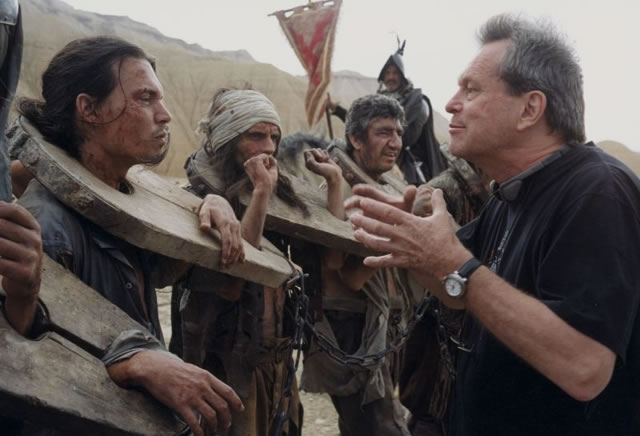
Wise: Terry Gilliam is a master of bringing dream visions to the screen. Unfortunately, that genius can sometimes devolve in nightmare. The documentary Lost in La Mancha (2002) chronicles Gilliam's failed attempt to bring Cervantes' classic Don Quixote to the multiplex.
Werth: Which was also a failed project that plagued Orson Welles.
Wise: Ever since a dispute with a producer hobbled the production of The Adventures of Baron Munchausen (1988), Gilliam has allowed documentarians onto his sets to help combat the (unfair) perception that his playful production style leads inexorably toward bloated fiascoes.
In the case of La Mancha, the desire to appear responsible may have led to disaster because the tight budget and even tighter shooting schedule ultimately could not withstand the catastrophes that plagued the project. Unable to gather his actors for rehearsal before the start of filming, Gilliam spends most of his pre-production time encouraging his team to be both whimsical and mindful of the budget.
When the first day of filming does arrive, momentum is slow to build as the cast attempts to cohere, then comes to a complete halt when NATO jets running maneuvers drown out the sound followed by a flash flood that sweeps away the set.
Werth: Top Gun meets Waterworld!
Wise: The problems mount until Gilliam's Quixote, French film legend Jean Rochefort, sustains an injury that forces him to drop out of the cast. The production team decides to shelve the project, but the film's insurers refuse to pay the claim, forcing Gilliam to continue making a film that can no longer be completed until the producers and the insurers reach an agreement.
Werth: Which sounds like the plot to a Terry Gilliam film.
Wise: It's hard to know what we've lost by not having the completed picture. The rushes included are arresting (particularly a shot of three giants lumbering over a mountain), although without context.
Johnny Depp does some fun mugging as a revamped Sancho Panza, but mostly he sits at the edge of the set smoking and watching disaster unfold. The best indication of what might have been is the delight that
Gilliam takes in the creations of his production team: he battles a phalanx of life-sized marionettes and predicts Oscars for his costume designer Gabriella Pescucci. There have been occasional rumors of Gilliam reviving the project in the decade since the documentary appeared, but so far all attempts seem to be mere tilting at windmills.
Werth: So, Wise, has our salute to Terry Gilliam inspired any new dreams for you?
Wise: Well, aside from White Christmases and Jeannies, I'll be dreaming of next week's Film Gab.
 It's a quiet week here in Film Gab's spacious Manhattan digs. Werth is off gallivanting through Europe doing his best Henry James impersonation, although with all his hair and none of the digestive complaints (we hope). The less picaresque half of Film Gab stuck around the city to get a little work done and dream of foreign shores. The combination of the two brings to mind those great Hollywood flicks where even those who stay at home get to take an incredible journey.