Friday, December 21, 2012

Hark! The Christmas Gabbers Sing

Werth: Merry Christmas, Wise!

Wise: Merry Christmas, Werth! What cinematic goodies do you hope to find underneath your tree?

Werth: This year the cinematic goodies will actually be in the movie theater because for the first time since 2009, they are releasing a big-budget movie musical on Christmas Day!

Wise: I assume you are referring to Les Miserables.

Werth: Oui! Tom Hooper's take on the trés populaire musical is sure to be on the wishlist of many a Holiday Musical fan.

Wise: But even if you can't make it to your local mega-plex this Christmas, Santa's little gabbers are here to suggest some other musicals for you to enjoy all snug in your bed.

Werth: If you like a little trannie glam-rock in your holidays, there is no better musical than the 2001 indie darling, Hedwig and the Angry Inch. Based on the successful off-Broadway play of the same name, Hedwig tells the life story of transgender rock goddess Hedwig (John Cameron Mitchell) whose national tour of the Bilgewater's restaurant chain smells like the end of the line. 
If performing on a small stage next to the all-you-can-eat seafood buffet wasn't bad enough, Hedwig's tour just happens to coincide with the sell-out stadium tour of her ex-lover, Tommy Gnosis (the eternally sketchy Michael Pitt).

Wise: I thought something smelled like fish.

Werth: Hedwig looks back over her life from her start as a young boy in Soviet East Germany to discovering Tommy in a trailer park in Junction City, Kansas with a mix of loving reverie and cocked eyebrow. 
Mitchell not only stars as Hedwig, but he also wrote and directed—which makes perfect sense when you realize that Mitchell has spent a lot of time in Hedwig's boots. He created the character in performances at gay rock club night "Squeezebox" at Don Hill's in Tribeca before expanding the character and creating the hit play. And Mitchell's mastery of this fascinating creature is evident as we watch Hedwig go through heartbreak, rock n' roll success, and the tragedy of a sex-change operation that got "botched." 
Mitchell plays for drag camp, but at the same time gives a depth and a sad irony to this character that makes this concoction of wild wigs, Eastern European lilt, and filthy excess feel real. 

Wise: At least more real than the Soviet gymnastics team in the early 80's.  

Werth: Visually Mitchell has fun transforming reality into a stage by blowing the walls off a trailer in "Wig in a Box" and turning a laundromat into an intimate cabaret in "Wicked Little Town," 
but the ending of the film is not as strong thematically as what was produced for the stage. Whether you're left with the urge to "pull a wig down from the shelf" or just confusedly scratch your head—Hedwig is a rock musical worth shoving in your holiday stocking.

Wise: In Cabaret (1972), Michael York plays Brian Roberts, a shy Englishman fleeing his stultifying homeland for the more decadent pleasures of Berlin in the final days of the Weimar Republic before Germany was overrun by the Nazis.  Once there, he takes a room in a boarding house where he meets Sally Bowles (Liza Minnelli), a singer at the tawdry Kit Kat Klub who has dreams of becoming a big star.  
The two become fast friends, occasional lovers, and eventually rivals for the affection of the same man, married playboy baron Maximilian von Heune (Helmut Griem).  

Werth: Tomorrow Belongs to Max.


Wise: The film is based on a stage musical of the same name which, in turn, was based on a play called I am a Camera adapted from the 1945 book The Berlin Stories by Christopher Isherwood.  Longtime choreographer Bob Fosse was determined to direct the film, but after his previous effort Sweet Charity (1969) disappointed at the box office, he was not exactly at the top of the producers' wish list.  
Still, he persisted, and through luck and hard work, he got the job and won an Oscar for bringing his peculiar and kinetic style to the project.  Most of the dramatic scenes employ the largely invisible camera work of classic Hollywood, 
but during the musical numbers the camera drops its disinterest and becomes a participant, nosing up to the dancers, zooming close to catch each jiggle and turn, then dashing around to capture the abstract shapes of the dancers' legs in strange poses that was part of Fosse' signature style.  
It's a far cry from the wall flower camera during Fred and Ginger's numbers. 

Werth: Art nerd alert—He also had some fun posing and dressing the Kit Kat Klub's audience to create living tableaux of works of German Expressionism from the era.

Wise: The film earned Liza Minelli an Oscar for Best Actress and catapulted her to stardom.  Her performance is exuberant and giddy, but with a core of tenderness that reveals an emotional frailty beneath Sally's high hopes.  Joel Grey is also excellent (and Oscar-winning) as the gender bending Emcee whose capers are both hilarious and unsettling.  
Michael York was not rewarded by the Academy, although his work as what amounts to a male ingenue, though muted, exhibits enough gravity to anchor the flamboyance of his co-stars.  Plus, his bee-stung lips and elegant neck are super dreamy. 

Werth: While we're left with visions of Michael Yorks dancing in our heads, we wish all of our faithful Film Gab readers a Merry Christmas—

Wise: —And come back next week for our New Year's edition of  Film Gab! 


Friday, December 14, 2012

Kiddie Lit-ter

Wise: Zzzzzzz...

Werth: Wake up, Wise.  It's time for Gab.
  
Wise: Sorry, work has been crazy and with the holiday season in full swing, I've been running myself ragged.  

Werth: You should relax.  Make yourself a hot chocolate and curl up with an old favorite book.  

Wise: I tried that. But I just nodded off.

Wise: Then maybe you should watch a favorite old book movie like The Hobbit which opens in theaters today. When I was a kid, Tolkien's book was all the rage and became a big screen cartoon starring the voices of John Huston, Otto Preminger, and Hans Conreid.

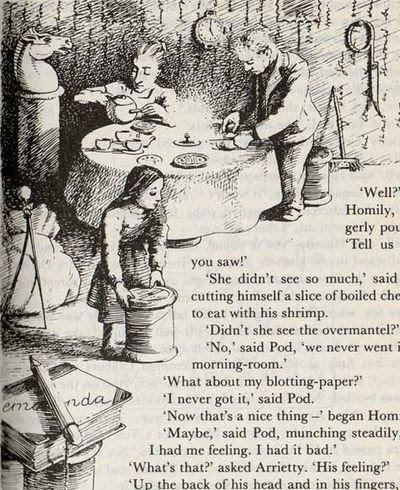
Wise: Popular childhood books always seem to make their way to the big screen. Published in 1952, Mary Norton's The Borrowers became an instant hit both in Great Britain and in the U.S.  The book features Arrietty, the adolescent daughter of Pod and Homily Clock, and her struggles as part of a tiny race of people known as Borrowers who live inside the walls of houses and make their living by "borrowing" from human "beans."  Their home is behind a hall clock inside an estate deep in the country, populated only by bedridden old Great Aunt Sophy and a cantankerous housekeeper and gardener.
Arrietty longs for companionship—the house is empty of little people except for her family—and she strikes up a tentative friendship with a human boy who has been sent to his great aunt in the country to recuperate from an illness.  Eventually, their friendship is discovered by her parents who insist she give it up and by Mrs. Driver, the cook, who enlists an exterminator to take care of what she thinks of as "vermin."  

Werth: I wish she would take care of my downstairs neighbor.

 
Wise: In the end, the Clocks must abandon their home and flee across the fields in hopes of finding other Borrowers who emigrated years before. It's something of a melancholy end to a book about loneliness, displacement and fear of the unknown.  The book's cliffhanger ending inspired four sequels and at least a half dozen film adaptations, each of which is more or less enjoyable, although none equal the original in emotional heft.  The book shares with a lot of other juvenile British classic a concern with the isolation of childhood and the fear of parental abandonment.  The films are mostly about special effects.  

Werth: Yeah, The Borrowers doesn't exactly lend itself to cinematic realism.


Wise: One of the earliest adaptations premiered in 1973 and starred Eddie Albert as Pod and Film Gab favorite Judith Anderson as a very tipsy Aunty Sophy.  Largely faithful to the book, the film suffers from an overly stately pace plus an expansion of the adult roles that leads to a lot of preening overacting by Albert that relegates Arrietty's longings to a subplot. 
Perhaps it's just as well because Canadian child actor Karen Pearson seems to have been cast more for her resemblance to Arrietty in Beth and Joe Krush's illustrations than for her acting ability.  Dennis Larson as the boy she befriends is even less compelling, although to be fair, both youngsters shared most of their scenes with a green screen instead of another actor.  

Werth: Judging from their IMDb movie resumes, I don't think we can blame the green screen. 


Wise: The 1997 Borrowers may be much less faithful, but it is filled with eye-popping special effects.  Exchanging Norton's late-Victorian setting for a storybook version of post-WWII England filled with late 20th century American product placements, the film is obviously attempting to capture the gross-out humor/kid revenge vibe of the Home Alone films.  John Goodman stars as Ocious P. Potter, a nasty lawyer invented for the film who is attempting to swindle away the house of the hapless Lender family.
Arrietty (Flora Newbigin) is joined by her screenwriter-invented younger brother Peagreen (a whiny Tom Felton before he went platinum and menaced a more famous Potter), and together they attempt to stop the villain with a lot of bathroom jokes and booby traps that tend to splatter.  Luckily, in this version Pod is played by Jim Broadbent who brings eager nobility and daft humor to help save the day.

Werth: Jim Broadbent's daft humor always saves the day.

Wise: There is also an adaptation written by animation genius Hayao Miyazaki for his Studio Ghibli that I haven't yet seen, although I've heard that it may come closest to capturing Norton's classic tale.   


Werth: While you're Netflixing that, some of my favorite books to read when I was a kid were about the ancient Greek myths. Like super-hero soap operas  from antiquity the stories of the Greek gods were a constant source of drama, lust and gore. And in 1981 director Desmond Davis brought all that fun to the big screen in Clash of the Titans. Clash tells the tale of Perseus, who starts off life being chucked in the ocean in a box with his mother because she had a baby out of wedlock.

Wise: Wow. I would think the ocean would have been full of boxes with babies and mamas.

Werth: Luckily for Perseus, the baby daddy is none other than king of the gods, Zeus (none other than king of the actors, Laurence Olivier). Zeus saves the boy and his mother and Perseus grows to be a strapping, bare-chested, pillow-lipped Harry Hamlin.

Wise: Pillow-lips seem to run in that family.

Werth: The plot of Clash, like the Greek myths it borrowed loosely from, becomes very complicated with Perseus' quest to save the beautiful Andromeda (Judi Bowker) taking him all over Greece. Perseus tracks down Stygian witches, battles Medusa, jousts with giant scorpions and faces off with the Kraken.
All this while a menagerie of gods bicker and vengeful ass-face Calibos (Neil McCarthy) does his best to kill the mighty hero. It's all great fun with a wonderfully campy crew playing Greeks and Olympians including Olivier, Maggie Smith, Ursula Andress (they gave her one line), Sian Phillips and Burgess Meredith playing the Greek version of Mickey Goldmill.


Wise: Better Mickey than the Penguin.


Werth: But the real star of this film is legendary special effects god, Ray Harryhausen. Using good, old-fashioned stop-motion puppetry, blue-screens, and matte painting, Harryhausen brought all the fantastical creatures from myth to life, and while none of them
look realistic by today's CGI-obsessed standards, Harryhausen's pets were good enough to strike terror into kids' hearts everywhere—especially a certain kid whose worst ophidiaphobe nightmare is a snake chick who has more snakes for hair.

Wise: I'm surprised you survived your initial viewing.

Werth: Harry Hamlin's gams kept my eyes off Medusa. Clash earned a bucketload for MGM and was even resurrected in 2010 for a more tech-savvy audience. It is one of those films that holds a revered place in my heart, because whenever I see it, I'll always be the myth-obsessed nine-year-old who wondered what it was like to be a hero... or a lady with snake hair.

Wise: Well Werth, I'm officially relaxed.

Werth: Good, but don't get too relaxed. You have to be ready next week for Film Gab's Christmas Spectacular! 


Friday, December 7, 2012

Gab Evening...

Werth: Hi there, Wise.  

Wise: Ho, ho, ho, Werth.  Will you help me unpack all these decorations?  

Werth: What is all this stuff?  I don't see any lights or tinsel, just fat suits and rubber masks.  

Wise: You're forgetting that it's the most important month on the Hollywood calendar—BioPic Season—when well-regarded actors ornament themselves with fake noses, false teeth, crazy accents or even a signature walk in an attempt to win Oscar gold.  And this year, no one is going flashier than Sir Anthony Hopkins in Hitchcock.  

Werth: Hopkins has pretty big pants to fill playing the iconic film director. Not only was Alfred Hitchcock a masterful director, but he was also an expert at marketing himself. Whether doing blink-and-you-miss-it cameos in his films or introducing his 1955-1961 television show, Hitchcock was as recognizable to his audience as his movies were. 

Wise: It also helps to have a profile that looks like a ham hock. 

Werth: One of my favorite Hitchcock flicks is the voyeuristic thriller, Rear Window (1954). Through a long, dialogue-free tracking shot Hitchcock sets up that Jeff Jeffries (Jimmy Stewart) is a photographer who has gotten the shot of a car wreck at a racetrack, but has also wound-up confined to a wheelchair in his apartment with a broken leg.

Wise: Jimmy always seems to get hurt with Hitchcock.

Werth: Jeff is in the catbird seat, though, when it comes to looking out his window which faces a courtyard ringed by the backsides of several apartment buildings. Like a wall of televisions, Jeff is able to see the goings on in his neighbors' New York apartments like the single, middle-aged Miss Lonelyhearts; the exercise-prone Miss Torso; and the piano-banging ladies' man Songwriter.

Wise: Add a Brazillian drum corps and you've got my neighborhood.

Werth: Jeff's girlfriend, Lisa (Grace Kelly in her second of three memorable Hitchcock outings), initially chastises Jeff for nosing in on his neighbors, but soon she too can't help but be drawn into the lives—real or imagined that they see through Jeff's window. The biggest draw is the apartment of Lars Thorwald (a grumpy Raymond Burr) where first Jeff and then Lisa begin to believe that a murder may have occurred.

Wise: I wish I could have murdered that Brazillian drum corps.

Werth: Hitchcock's camerawork for Rear Window is nothing short of miraculous. Using POV shots, the mobile camera seems trapped with Jeff and us in this apartment giving us equal parts peeping tom kick and frustration at not being able to get another vantage point. 
The camera in this film only shows us what we can see from Jeff's apartment—and allows us as well as Jeff and Lisa to imagine what could have happened behind the pulled down shade of the Thorwald bedroom. 
The old saw of not seeing being more suspenseful than seeing is given an ingenious twist that makes this film one of Hitchcock's best, earning him the fourth of his five Oscar noms. That, and it has Thelma Ritter in it, which is always a plus in my book.

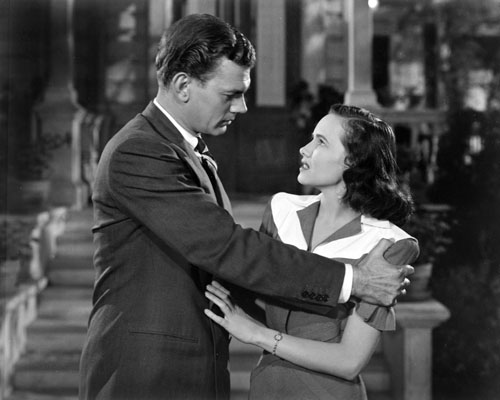
Wise: In Shadow of a Doubt (1943), Joseph Cotten plays a man on the lam who turns up at his sister's home in idyllic suburban California where his adoring teenage niece (Teresa Wright) begins to suspect his unsavory past.  When two men show up pretending to take a survey of the average American family, one of them takes Wright's Young Charlie aside and tells her that they are detectives and suspect that her uncle is the notorious Merry Widow serial killer.  Charlie goes from idolizing her uncle to fearing him as a series of small accidents begins to make her think he is trying to kill her.  

Werth: She should be fine as long as she's not a Merry Widow, right?

Wise: The film has all of Hitchcock's signature themes—paranoia, moral ambiguity, black humor—but it also features something unusual for the Master of Suspense: children.  Co-screenwriter Sally Benson was the author of the memoir upon which Meet Me in St. Louis was based, making her an attractive collaborator for a film about an adolescent girl's anxieties.  But in addition to creating Esther Smith's romantic dilemmas, she also birthed Tootie's obsession with killing and burying her dolls in the backyard.  
Charlie's younger sister Ann is bookish and condescending toward their father's (Henry Travers) habit of plotting out fictitious murders with the neighbor (an hilarious Hume Cronyn), while her little brother Roger is too obsessed with numbers to care much about the adults around him. 

Werth: Only the Pop O Matic Bubble can keep this family together!

Wise: The film also plays with identity in a clever way.  Young Charlie shares a name with her uncle and throughout Hitchcock photographs them in similar positions and attitudes to heighten the similarities between the two.  As Young Charlie begins to suspect her uncle's perfidy, she is also beginning to doubt herself, fearing that the connection they share is actually evil.

Werth: Judging from her dresses, she may share Joseph Cotten's shoulders.

Wise: Shadow cleverly merges small town nostalgia with film noir, upending platitudes about neighborliness and good will with murky morals and staircases that suddenly give way.  Hometown life transforms from a haven into trap.  


Werth: I look forward to seeing if Anthony Hopkins can avoid the trap of hamming up his performance as the Master of Suspense.

Wise: I just hope they play the theme song. See you next week Film Gabbers!