Werth: You know what, Wise?
Wise: What's that, Werth?
Werth: I'd really like to thank the Acadamy.
Wise: Because they like you, they really like you?
Werth: No, because the Oscar telecast finally recognized Oscar losers. I'm not gonna say that host Seth MacFarlane and Kristin Chenoweth stole our idea, but we have mined this territory twice before.
Wise: It seems Mr. MacFarlane did a lot of things to ruffle people's feathers at the Oscars.
Werth: One person who must have been super ruffled was legendary film director, Steven Spielberg. His hugely successful bio-pic Lincoln lost Best Picture and, more surprisingly, Best Director.
Wise: And not just because historical bio-pics are usually a shoo-in at the Academy Awards.
Werth: But Spielberg might be used to losing Oscars on his slavery-themed movies. The Color Purple (1985) was famously nominated for 11 Oscars and lost every single one. But perhaps less remembered is Spielberg's cinematic treatment of a group of Africans who escape a slave ship in 1839, only to be put on trial here in America, Amistad (1997). The film was nominated for four Oscars and lost them all.
Wise:Most of the gold that year went to another film about an ill-fated ship.
Werth: Amistad is based on the true story of a group of Africans who are kidnapped and sent to Cuba before rising up against their captors, slaying them, and then trying to steer their boat home. Unfortunately they wind-up off Long Island, and are soon in shackles again for murder.
They become the center of an international property dispute that quickly leads to Presidential involvement due to the case's ramifications to American slavery. It's the sort of epic human issue canvas that Spielberg loves to paint on.
Wise: Munich, anyone?
Werth: The film veers between heavy-handedness, perceptive humor and stark, shocking realism, but the real joy in this film is to watch the performances. Morgan Freeman gives his typical charming and noble turn as freed slave Theodore Joadson, and Matthew McConaughey is spunky and eager as the defense attorney for the Africans, Roger Sherman Baldwin.
But the two standouts are Djimon Hounsou as Cinque and Anthony Hopkins as former president John Quincy Adams. Hounsou is a revelation, his imposing screen presence a mix of sheer physical size, vocal roar, and intensity.
Hopkins works magic by throwing himself whole hog into this addled and rickety, irascible and brilliant man. The scene where we first see Adams "napping" in Congress is textbook perfection of how to introduce a character with only a simple shot and one line of dialogue.
Hopkins lost the best Supporting Oscar to Robin Williams in Good Will Hunting and Spielberg wasn't even nominated. So my guess is Spielberg will avoid slavery flicks for a little while.
Wise: Perhaps there's no better example of an Oscar loser than Bette Davis in Of Human Bondage (1934). Based on the novel by W. Somerset Maugham, the film also stars Leslie Howard as Philip Carey, a club-footed aesthete who abandons his dream of studying art in Paris and returns to study medicine in London where he falls for cockney waitress Mildred (Davis). He lavishes attention on her, but she prefers the company of wealthier men who enjoy life's rowdier pleasures and aren't burdened by a dysfunctional leg.
Werth: I'm with ya' Mildred.
Wise: Mildred runs off with another man, but comes back destitute and pregnant. Philip takes her in, but just as she makes it back on her feet, she runs off again beginning a cycle that results in both spiraling out of control. Along the way, Philip finds comfort in the friendship he develops with a patient (Reginald Owen) and his daughter (Frances Dee).
Werth: But Mildred's more fun.
Wise: This was the picture that made Davis' career. She had been laboring in smaller films at Warner Bros., but when Bondage director John Cromwell caught of preview of one of Davis' performances, he insisted on borrowing her for the film. Legend has it that the Warner brass was happy to have the tempestuous actress off the lot for a few weeks, but were furious when their contract player was transformed into a star by another studio and quietly encouraged the Academy not to nominate Davis.
A furious write-in campaign erupted, but despite the best efforts of her peers, Davis still lost the Oscar to Claudette Colbert for It Happened One Night. Still, Davis is magnificent playing both the slatternly Mildred and Philip's fantasy vision of her: tender, compliant, virginal in softly-lit, frothy white dresses. She even gets an incredible breakdown scene where she rages at Philip's impotence and later almost destroys his chances of finishing medical school.
Werth: No actress has ever done as much with the line "Wipe my mouth."
Wise: It's really an amazing performance, full of vibrance, passion, and wit.
Werth: Which is more than I can say for this year's Oscars ceremony.
Wise: Perhaps next year we can host— but until then, check in next week for more Film Gab!
Werth: Hi there, Wise.
Wise: Ho, ho, ho, Werth. Will you help me unpack all these decorations?
Werth: What is all this stuff? I don't see any lights or tinsel, just fat suits and rubber masks.
Wise: You're forgetting that it's the most important month on the Hollywood calendar—BioPic Season—when well-regarded actors ornament themselves with fake noses, false teeth, crazy accents or even a signature walk in an attempt to win Oscar gold. And this year, no one is going flashier than Sir Anthony Hopkins in Hitchcock.
Werth: Hopkins has pretty big pants to fill playing the iconic film director. Not only was Alfred Hitchcock a masterful director, but he was also an expert at marketing himself. Whether doing blink-and-you-miss-it cameos in his films or introducing his 1955-1961 television show, Hitchcock was as recognizable to his audience as his movies were.
Wise: It also helps to have a profile that looks like a ham hock.
Werth: One of my favorite Hitchcock flicks is the voyeuristic thriller, Rear Window (1954). Through a long, dialogue-free tracking shot Hitchcock sets up that Jeff Jeffries (Jimmy Stewart) is a photographer who has gotten the shot of a car wreck at a racetrack, but has also wound-up confined to a wheelchair in his apartment with a broken leg.
Wise: Jimmy always seems to get hurt with Hitchcock.
Werth: Jeff is in the catbird seat, though, when it comes to looking out his window which faces a courtyard ringed by the backsides of several apartment buildings. Like a wall of televisions, Jeff is able to see the goings on in his neighbors' New York apartments like the single, middle-aged Miss Lonelyhearts; the exercise-prone Miss Torso; and the piano-banging ladies' man Songwriter.
Wise: Add a Brazillian drum corps and you've got my neighborhood.
Werth: Jeff's girlfriend, Lisa (Grace Kelly in her second of three memorable Hitchcock outings), initially chastises Jeff for nosing in on his neighbors, but soon she too can't help but be drawn into the lives—real or imagined that they see through Jeff's window. The biggest draw is the apartment of Lars Thorwald (a grumpy Raymond Burr) where first Jeff and then Lisa begin to believe that a murder may have occurred.
Wise: I wish I could have murdered that Brazillian drum corps.
Werth: Hitchcock's camerawork for Rear Window is nothing short of miraculous. Using POV shots, the mobile camera seems trapped with Jeff and us in this apartment giving us equal parts peeping tom kick and frustration at not being able to get another vantage point.
The camera in this film only shows us what we can see from Jeff's apartment—and allows us as well as Jeff and Lisa to imagine what could have happened behind the pulled down shade of the Thorwald bedroom.
The old saw of not seeing being more suspenseful than seeing is given an ingenious twist that makes this film one of Hitchcock's best, earning him the fourth of his five Oscar noms. That, and it has Thelma Ritter in it, which is always a plus in my book.
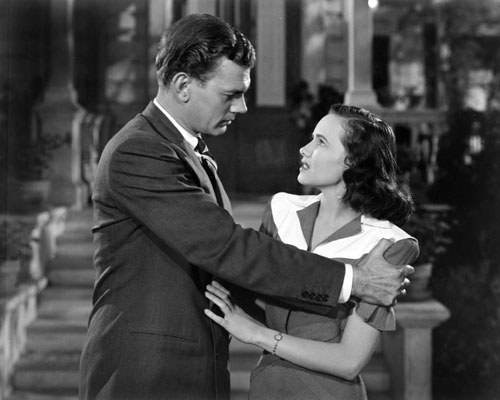
Wise: In Shadow of a Doubt (1943), Joseph Cotten plays a man on the lam who turns up at his sister's home in idyllic suburban California where his adoring teenage niece (Teresa Wright) begins to suspect his unsavory past. When two men show up pretending to take a survey of the average American family, one of them takes Wright's Young Charlie aside and tells her that they are detectives and suspect that her uncle is the notorious Merry Widow serial killer. Charlie goes from idolizing her uncle to fearing him as a series of small accidents begins to make her think he is trying to kill her.
Werth: She should be fine as long as she's not a Merry Widow, right?
Wise: The film has all of Hitchcock's signature themes—paranoia, moral ambiguity, black humor—but it also features something unusual for the Master of Suspense: children. Co-screenwriter Sally Benson was the author of the memoir upon which Meet Me in St. Louis was based, making her an attractive collaborator for a film about an adolescent girl's anxieties. But in addition to creating Esther Smith's romantic dilemmas, she also birthed Tootie's obsession with killing and burying her dolls in the backyard.
Charlie's younger sister Ann is bookish and condescending toward their father's (Henry Travers) habit of plotting out fictitious murders with the neighbor (an hilarious Hume Cronyn), while her little brother Roger is too obsessed with numbers to care much about the adults around him.
Werth: Only the Pop O Matic Bubble can keep this family together!
Wise: The film also plays with identity in a clever way. Young Charlie shares a name with her uncle and throughout Hitchcock photographs them in similar positions and attitudes to heighten the similarities between the two. As Young Charlie begins to suspect her uncle's perfidy, she is also beginning to doubt herself, fearing that the connection they share is actually evil.
Werth: Judging from her dresses, she may share Joseph Cotten's shoulders.
Wise: Shadow cleverly merges small town nostalgia with film noir, upending platitudes about neighborliness and good will with murky morals and staircases that suddenly give way. Hometown life transforms from a haven into trap.
Werth: I look forward to seeing if Anthony Hopkins can avoid the trap of hamming up his performance as the Master of Suspense.
Wise: I just hope they play the theme song. See you next week Film Gabbers!
Wise: Hi there, Werth.
Werth: .esiW, ydwoH
Wise: Um, what's going on? Why are you dancing around in a red velvet suit and flashing a strobe light?
Werth: !yadhtrib s'hcnyL divaD gintarbelec m'I
Wise: Wait, is that cherry pie? A snakeskin jacket? And Richard Farnsworth on a tractor? It must be David Lynch's birthday!
Werth: Exactly. And what better way to salute one of cinema's truly unique auteurs than to Gab about two of his best flicks?
Wise: I'll grab a log and see if David Duchovny can still fit into a dress.
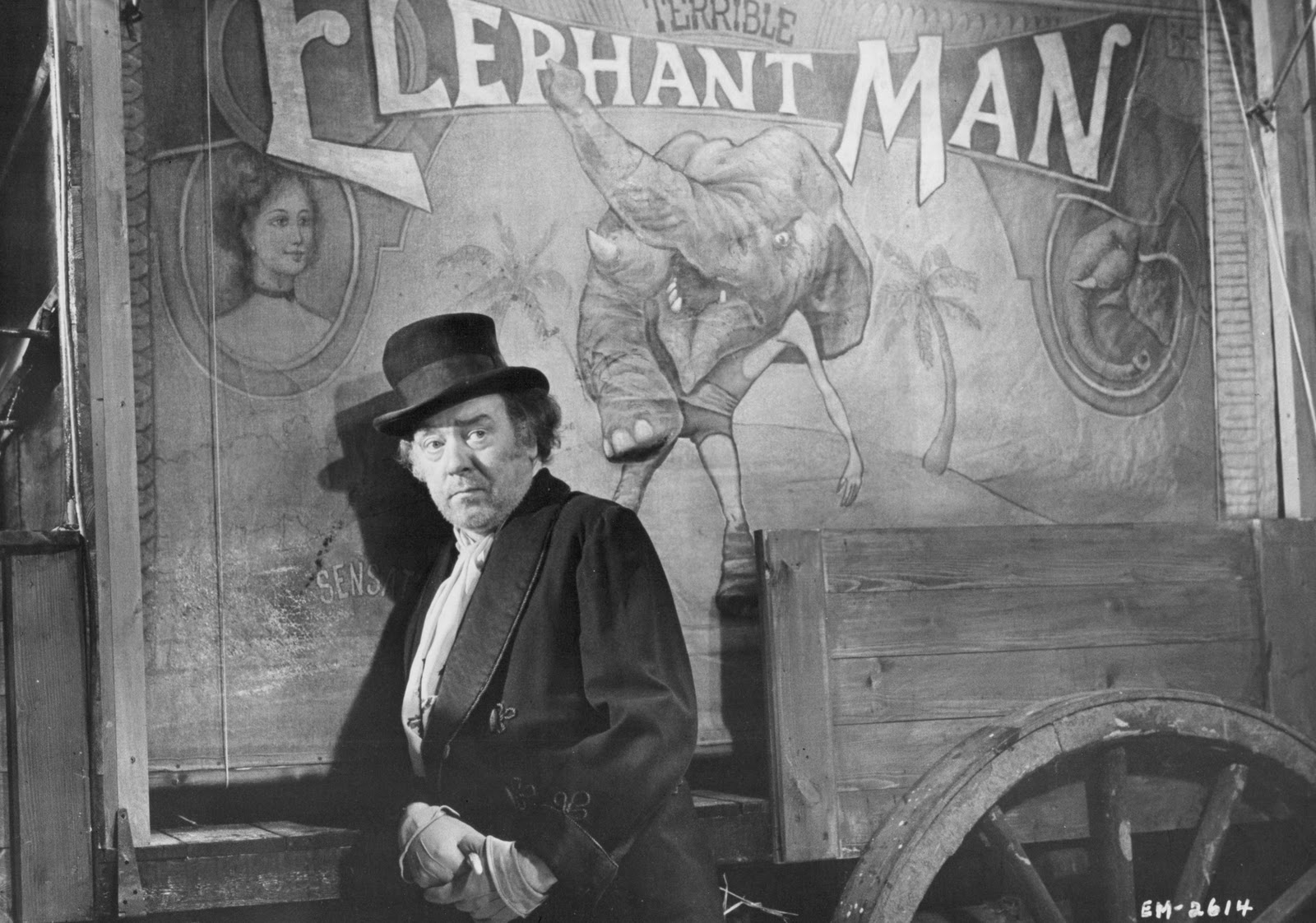
Werth: It's hard to believe it now, but for his first studio film, Lynch avoided twisty mystery plots, ultra-violence and aliens and instead produced a heartbreaking, Oscar-nominated drama. The
Elephant Man (1980) is based on the true story of Joseph Merrick (re-named John in the film to follow the real-life Dr. Treves' journal entries), a Victorian Era man who was horribly disfigured by a then unknown genetic disease. Dr. Treves (Anthony Hopkins) finds Merrick (John Hurt) in a freak show where he is treated as a horrifying grotesque causing women to faint and righteous men to howl about "abominations."
Wise: Kind of like Melanie Griffith's plastic surgery.
Werth: Dr. Treves rescues Merrick from his abusive owner and puts him up in London Hospital where he discovers that this Elephant Man is actually an intelligent, curious human being who makes models of cathedrals and quotes the Psalms. But sadly, there is no Dumbo happy ending for Mr. Merrick—which is where Lynch's unique, dark style of filmmaking comes in.
Mimicking some aspects of his first film, cult favorite Eraserhead (1977), Lynch films his vision of Victorian England in black and white, making it dark, dingy and ugly. The filthy machines of the Indrustrial Age choke the air and chop up men and their souls, leaving madness, depravity, and contempt around every corner. But the world is not devoid of kindness.
Dr. Treves, hospital administrator Carr Gomm (John Gielgud), famous actress Mrs. Kendal (Anne Bancroft) and head nurse Mothershead (Dame Wendy Hiller) all discover Merrick's hidden beauty and attempt to nourish and protect him.
Wise: Dame Wendy is the hidden beauty in every film she's in.
Werth: But Lynch doesn't limit himself to the traditional structures of a historical drama. Surreal nightmares and a beautiful visual daydream of the joy and escapism of theater are evidence of Lynch's evolving, non-realistic style. Sound design is overemphasized with clacking shoes, hissing gas lamps and screaming train whistles giving scenes an other-worldly feel. Even his editing skips ahead in time, cutting out details from scenes without losing their essence.
Roger Ebert, among other critics, accused Lynch of sentimentality, but Lynch is more restrained than most directors at dramatic climaxes. Many of the most gut-wrenching scenes are performed without underlying orchestration, allowing the realistic acting of this talented cast to tell the tragic story of a beautiful soul trapped in a monstrous body and an even more monstrous world.

Wise: That's part of what makes Lynch such a fascinating filmmaker: how intimately he observes the details of everyday life and how those same details can suddenly turn monstrous. And nowhere is that slippery connection more apparent than in Blue Velvet (1986), the story of a small town boy, Jeffrey Beaumont (Kyle MacLachlan), who finds a severed ear in a field and discovers the sordid dealings beneath the idyllic surface of his hometown. Along the way, he nearly loses his girlfriend Sandy Williams (Laura Dern), falls for the self-destructive allure of Dorothy Vallens (Isabella Rossellini), and has to escape the machinations of gangster Frank Booth (Dennis Hopper).
Werth: Not to mention showing off his tuckus!
Wise: After his big-budget adaption of Frank Herbert's sci-fi epic Dune (1984) bombed at the box office, Lynch was relegated to the lower rungs of the Hollywood ladder until legendary producer Dino De Laurentiis gave him another shot (and a much smaller budget).
Tellingly, the constricted circumstances freed Lynch's powers, and—away from the monstrous worms and overblown space fantasy—he is able to address more personal themes: curiosity, innocence, depravity, love, and violence.
Werth: Sounds like the usual Friday night at Mel Gibson's house.
Wise: The film isn't always pleasant to watch, but it's almost impossible to look away. There's rape, murder and every other stripe of brutality you can imagine, plus Dennis Hopper's Frank may be one of the most compelling villains in film: a sadist who weeps at Rossellini's torch songs, tortures her, and then caps it off by huffing a mysterious gas from a hospital mask.
Werth: All of that is great, but I still don't know whose ear is in that field!
Wise: Maybe Mr. Lynch will let us know in next week's Film Gab!
Wise: Happy Halloween, Werth!
Werth: Boo to you too, Wise. Any plans for the year's most haunted evening?
Wise: I thought I might curl up at home with a bowl of candy corn and a double feature of scary movies.
Werth: Vincent Price in House of Wax and Bette Davis in The Nanny?
Wise: Actually, I was thinking more along the lines of Katherine Heigl in 27 Dresses and The Ugly Truth.
Werth: Heigl is a special kind of terrifying, but when I think of movies that scare me, only one movie is a guaranteed nightmare-causer, Stanley Kubrick's The Shining (1980).
Wise: I hope that has nothing to do with my unfortunate, one-time comment about Noxzema and your T-zone.
Werth: Based on the Stephen King novel, The Shining stars Jack Nicholson as Jack Torrance, a writer who packs up his wife Wendy (Shelley Duvall) and young son Danny (Danny Lloyd) to be the caretaker of a closed-for-the-season hotel in the snowbound Colorado mountains. But the Torrance family is not alone in the Overlook Hotel, and soon the dark spirits that haunt the halls give a whole new meaning to cabin fever.
The film is full of iconic horror images: REDRUM, Nicholson's face grinning through a hacked-open door, and those god-damned twins.
Wise: I assume you're not referring to the Olsens.
Werth: As with all of his films, Kubrick takes his time. The dread and fear of The Shining builds slowly with long tracking shots that follow Danny on his three-wheeler, holding us spellbound waiting for the horrors waiting around the next corner.
Kubrick uses the Overlook itself to put the audience on edge. The large ballrooms, hallways and rooms feel strangely claustrophobic, the emptiness of a normally bustling place causing an unease that leads to madness. And don't get me started on how uncomfortable the soundtrack makes me.
Wise: Let's not forget Jack O'Nicholson.
Werth: Let's not! Nicholson's angular eyebrows and wicked leer telegraph from the beginning that homicidal tendencies are not buried too deeply beneath his skin. While this makes his transformation less surprising, it is still, nonetheless, horrifying. Young Lloyd is ingenious, playing a kid's role that could be considered grounds for child abuse.
But my favorite performance is from Duvall. Her bug-eyed awkwardness is perfect as she struggles to save herself and her son from the monster her husband has become—or perhaps always was. Behind the scenes footage shot by Kubrick's wife shows Kubrick assailing poor Duvall about her acting, turning her into a weeping, nerve-wracked mess. Whether Kubrick intended to shape Duvall's perforamnce or was just being an a-hole, in the end, Duvall, pardon the pun, shines.
Wise: Perhaps I'll postpone my Heigl-fest and delve into Francis Ford Coppola's foray into the blood-sucking undead, Bram Stoker's Dracula.
Werth: Because Francis Ford Coppola's Dracula wouldn't fit on the marquees.
Wise: It was an attempt to bring the character closer to Stoker's original novel and away from the sinister elegance of Bela Lugosi's iconic version from the 1930's.
Coppola begins the story in the 15th Century with a young and handsome Vlad Dracula (Gary Oldman) heading off to defend his castle and his bride from invading forces. He defeats his enemies, although their treachery has convinced his young wife Elisabeta (Winona Ryder) that he has died in battle and she flings herself from the castle tower.
Werth: Tragically ending her budding medieval shoplifting career.
Wise: Heartbroken, the Count renounces his faith and swears allegiance to the darkness. Skipping ahead 400 years, the film finds young lawyer Jonathan Harker (Keanu Reeves) embarking on a business trip to Transylvania, but not before promising to marry his fiancée Mina (also Ryder) immediately upon his return.
Imprisoning Harker with his three succubus brides, the Count journeys to London where he recognizes Mina as the image of his lost love and hatches a plan to seduce her into his undead existence.
Werth: That's a lot of plot.
Wise: And there's a lot more involving Hungarian nuns, a ruined Abby, gypsies, escaped wolves, a nickelodeon theater, grave robbing, stormy sea crossings, and stage coach chases.
Werth: It's a grab bag of movie clichés.
Wise: The movie itself is a mélange of styles and images: 19th Century paintings mixed with Byzantine design, classic Hollywood cinematography with 1960's cinema psychedelia, and capped off with a cast list that looks like credits on the best slacker film never made: Ryder, Reeves, Cary Elwes, Billy Campbell, Richard E. Grant, Tom Waits, plus Anthony Hopkins as grizzled vampire hunter Van Helsing.
Werth: Reality Bites Before Sunrise.
Wise: Something like that. It's a weird mix of compelling and preposterous, but filled with definite chills and a few blood-spurting scares.
Werth: Sounds like someone will be sleeping with a stake and a garlic necklace until Halloween is over.
Wise: Heck, I'll even pop Katherine Heigl in Killers into the DVD player to keep the undead away until next week's Film Gab.