Showing posts with label Grace Kelly. Show all posts

Friday, December 7, 2012

Gab Evening...

Werth: Hi there, Wise.  

Wise: Ho, ho, ho, Werth.  Will you help me unpack all these decorations?  

Werth: What is all this stuff?  I don't see any lights or tinsel, just fat suits and rubber masks.  

Wise: You're forgetting that it's the most important month on the Hollywood calendar—BioPic Season—when well-regarded actors ornament themselves with fake noses, false teeth, crazy accents or even a signature walk in an attempt to win Oscar gold.  And this year, no one is going flashier than Sir Anthony Hopkins in Hitchcock.  

Werth: Hopkins has pretty big pants to fill playing the iconic film director. Not only was Alfred Hitchcock a masterful director, but he was also an expert at marketing himself. Whether doing blink-and-you-miss-it cameos in his films or introducing his 1955-1961 television show, Hitchcock was as recognizable to his audience as his movies were. 

Wise: It also helps to have a profile that looks like a ham hock. 

Werth: One of my favorite Hitchcock flicks is the voyeuristic thriller, Rear Window (1954). Through a long, dialogue-free tracking shot Hitchcock sets up that Jeff Jeffries (Jimmy Stewart) is a photographer who has gotten the shot of a car wreck at a racetrack, but has also wound-up confined to a wheelchair in his apartment with a broken leg.

Wise: Jimmy always seems to get hurt with Hitchcock.

Werth: Jeff is in the catbird seat, though, when it comes to looking out his window which faces a courtyard ringed by the backsides of several apartment buildings. Like a wall of televisions, Jeff is able to see the goings on in his neighbors' New York apartments like the single, middle-aged Miss Lonelyhearts; the exercise-prone Miss Torso; and the piano-banging ladies' man Songwriter.

Wise: Add a Brazillian drum corps and you've got my neighborhood.

Werth: Jeff's girlfriend, Lisa (Grace Kelly in her second of three memorable Hitchcock outings), initially chastises Jeff for nosing in on his neighbors, but soon she too can't help but be drawn into the lives—real or imagined that they see through Jeff's window. The biggest draw is the apartment of Lars Thorwald (a grumpy Raymond Burr) where first Jeff and then Lisa begin to believe that a murder may have occurred.

Wise: I wish I could have murdered that Brazillian drum corps.

Werth: Hitchcock's camerawork for Rear Window is nothing short of miraculous. Using POV shots, the mobile camera seems trapped with Jeff and us in this apartment giving us equal parts peeping tom kick and frustration at not being able to get another vantage point. 
The camera in this film only shows us what we can see from Jeff's apartment—and allows us as well as Jeff and Lisa to imagine what could have happened behind the pulled down shade of the Thorwald bedroom. 
The old saw of not seeing being more suspenseful than seeing is given an ingenious twist that makes this film one of Hitchcock's best, earning him the fourth of his five Oscar noms. That, and it has Thelma Ritter in it, which is always a plus in my book.

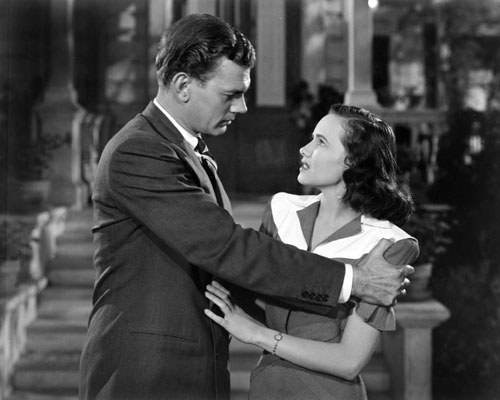
Wise: In Shadow of a Doubt (1943), Joseph Cotten plays a man on the lam who turns up at his sister's home in idyllic suburban California where his adoring teenage niece (Teresa Wright) begins to suspect his unsavory past.  When two men show up pretending to take a survey of the average American family, one of them takes Wright's Young Charlie aside and tells her that they are detectives and suspect that her uncle is the notorious Merry Widow serial killer.  Charlie goes from idolizing her uncle to fearing him as a series of small accidents begins to make her think he is trying to kill her.  

Werth: She should be fine as long as she's not a Merry Widow, right?

Wise: The film has all of Hitchcock's signature themes—paranoia, moral ambiguity, black humor—but it also features something unusual for the Master of Suspense: children.  Co-screenwriter Sally Benson was the author of the memoir upon which Meet Me in St. Louis was based, making her an attractive collaborator for a film about an adolescent girl's anxieties.  But in addition to creating Esther Smith's romantic dilemmas, she also birthed Tootie's obsession with killing and burying her dolls in the backyard.  
Charlie's younger sister Ann is bookish and condescending toward their father's (Henry Travers) habit of plotting out fictitious murders with the neighbor (an hilarious Hume Cronyn), while her little brother Roger is too obsessed with numbers to care much about the adults around him. 

Werth: Only the Pop O Matic Bubble can keep this family together!

Wise: The film also plays with identity in a clever way.  Young Charlie shares a name with her uncle and throughout Hitchcock photographs them in similar positions and attitudes to heighten the similarities between the two.  As Young Charlie begins to suspect her uncle's perfidy, she is also beginning to doubt herself, fearing that the connection they share is actually evil.

Werth: Judging from her dresses, she may share Joseph Cotten's shoulders.

Wise: Shadow cleverly merges small town nostalgia with film noir, upending platitudes about neighborliness and good will with murky morals and staircases that suddenly give way.  Hometown life transforms from a haven into trap.  


Werth: I look forward to seeing if Anthony Hopkins can avoid the trap of hamming up his performance as the Master of Suspense.

Wise: I just hope they play the theme song. See you next week Film Gabbers!


Friday, July 13, 2012

BAM Graces Grace

As if today's launch of Film Forum's tribute to Universal Studios wasn't enough, BAM is celebrating one of cinema's coolest blondes with a Grace Kelly Film Festival. With such great classics as High Noon (1952), Rear Window(1954), To Catch a Thief (1955) and her oscar-winning turn in The Country Girl (1954) on the bill, Grace is sure to give you a cool escape from the summer heat. 

Thursday, June 16, 2011

Dial F for Film Forum!

Didn't know that the Hitchcock classic Dial M for Murder (1954) had a limited release in 3-D?  Well it did, and starting Friday 6/17 for one week only, Film Forum is showing Grace Kelly and Ray Milland in Naturalvision 3D. Don't miss this classic thriller that reminds you to always keep a pair of scissors on your desk!

Friday, March 4, 2011

Oscar? I Hardly Know Her!

Werth: Welcome to our First Annual Oscar Post-Show Wrap-up, Wise!

Wise: It’s good to be here, Werth.

Werth: So since everyone else has re-hashed the ceremony, the winners, the fashions—

Wise: —Melissa Leo’s F-bomb—
Werth: —and Charlie Sheen.

Wise: Charlie Sheen wasn’t at the Oscars.

Werth: I know, but everyone keeps talking about him.  So, we here at Film Gab are going to focus on an overlooked Oscar topic—

Wise: The losers. It must be terrible riding high on the rush of earning a nomination, being feted all over town, getting gussied up by some chic designer for the red carpet strut only to come crashing back to earth when someone else’s name is read.  And the worst part is having your disappointment broadcast around the globe.

Werth: I think the biggest loser this year had to be beautiful, classy, and amazingly talented Annette Bening.

Wise: Because she’s married to Warren Beatty?

Werth: Because she’s been left at the altar four times by old man Oscar.

Wise: Always a bridesmaid, never a bride... except to Warren Beatty.

Werth: But Annette should take heart! She is in good best actress loser company. In fact, in 1951, there were two monumental lady losers.

Wise: I’ll bet neither of them was married to Warren Beatty.

Werth: Not that we know of. The Best Actress category at the 1951 Oscars had two of the most iconic performances in film history going head-to-head: Bette Davis’ willfull, grand dame of the theater Margot Channing in All About Eve; and Gloria Swanson’s neurotic, silent-film star Norma Desmond in Sunset Boulevard.

Wise: Now THAT’S a film character throw-down I’d like to see!

Werth: Lots of name-calling, nail-scratching and smoking. Helped along by Joseph L. Mankiewicz’s Oscar-winning dialogue, Davis is a force of nature in All About Eve as the aging theater star who has to ward off the advances of an ambitious underling. She is tough, elegant, funny and at certain moments, vulnerable. Davis’ song-worthy eyes flash with an intensity that goes beyond mere performance. She becomes Channing and endows her with the fire that made Davis one of the most fascinating actresses, and Channing one of her most fascinating characters.

Wise: Until she did Whatever Happened to Baby Jane?

Werth: Speaking of crazy old ladies, Davis’ 1951 formidable competition came from an old, silent film star playing an old, silent film star. By the time Gloria Swanson made Sunset Boulevard she was already a Hollywood legend, but she had been out of the limelight for many years. So her turn as forgotten silent screen siren Norma Desmond seemed eerily close to home. Swanson always declared she was nothing like Desmond, which is good to hear. As Desmond, her wide-eyed focus, her grandly inflected voice, her flailing gestures with a wire cigarette holder clutching her finger are so over-the-top that her desperation practically reaches through the screen to grab and shake you. Swanson’s genius was to make this grand Guignol character noble and proud, so that as she descended into madness, we pitied instead of laughing at her.

Wise: It would be hard to choose which performance deserved the Oscar more.

Werth: Apparently Academy members that year felt the same way, because they gave the statuette to Judy Holliday for her brilliantly funny turn as a goofy mob moll in Born Yesterday. Neither Davis nor Swanson would ever win another Oscar, but perhaps they get the last laugh as their star turns in these two films have become ingrained in our culture whereas Holliday (despite her amazing talents) has faded into the shadows of these two “losers.”

Wise: It is interesting how shortsighted the Oscars can sometimes be.  What seems like the performance of the year, can quickly fade from memory, while an overlooked performance emerges as iconic.  

Werth: Ya’ hear that Natalie P.?  

Wise: If we’re discussing Oscar’s losers, then I don’t think there are many better examples than Judy Garland’s loss to Grace Kelly in 1954, partly because Garland performance in A Star is Born is the best of her career, but mostly because Grace Kelly’s emotional turn in  The Country Girl has been almost completely overshadowed by the image of icy blond perfection she epitomized while working with Hitchcock in  Rear Window and To Catch a Thief.  The Country Girl was an unglamorous departure for Kelly—

Werth: And we all know how the Academy loves to reward beautiful actresses for playing “ugly”... or demented ballerina bird chicks.  

Wise: Still, as good as she is in the role of long-suffering wife of drunk actor Bing Crosby, she just doesn’t compare to Garland—

Werth: Playing the long-suffering wife of drunk actor James Mason.  

Wise: Garland’s performance is full of subtlety, drama, histrionics and gentleness, plus she sings.  A Star is Born was supposed to be a triumph for Garland.  Four years earlier, she had been fired by MGM and plenty of Hollywood wags has assumed her career was over, but after a spectacularly successful concert tour, she set up Star at Warner Bros. with the help of her husband/manager Sid Luft.  At MGM, Garland had always been surrounded by sophistication and swooning violins.  Decamping to Warner allowed her to tackle grittier subject matter, and in Star she is absolutely heartbreaking as a woman undone by love.  The producers of the Academy Awards telecast were so certain that Garland would win that they dispatched a camera crew to the hospital room where she was recuperating from the birth of her son Joey.  

Werth: And then she lost.

Wise: And the crew packed up and left without saying a word.  At least she got a telegram from Groucho Marx who called it the “biggest robbery since Brinks.”  

Werth: Too bad a telegram doesn’t look as good on the mantlepiece as a shiny gold statuette.  


Wise: I wonder if we’d get the telegram or the statuette for Best Performance by a Classic Film Blog Duo.

Werth: Let’s go for the telegram. Oscar losers rock!  

Wise: Tune in to Film Gab next week for more cinematic winners and losers.