Werth: Hello, Wise.
Wise: Howdy, Werth. Do you happen to know if there's a Hot Topic here in Manhattan, or do I need to head to a mall somewhere in New Jersey?
Werth: Are you all out of black nail polish and fishnet tights?
Wise: Of course not, but I do need some supplies to get my goth fangirl on because Tim Burton's latest stop-motion animation film Frankenweenie opens today. This calls for a new Emily the Strange lunchbox!
Werth: More than that, Wise. It calls for a Film Gab salute to the multiple stop-motion animated films in Burton's oeuvre.
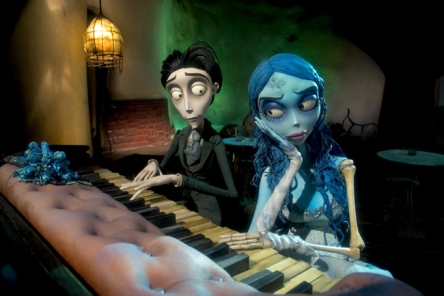
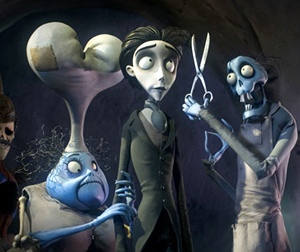
Wise: I couldn't agree more. Corpse Bride (2005) relates the unlikely tale of Victor Van Dort (Johnny Depp), the shy son of arriviste fish merchants who is pledged to marry the daughter of a titled but broke noble family (Emily Watson as a very plucky Victoria Everglott) only to have those plans interrupted by an accidental union with the titular decomposing lady (Helena Bonham Carter).
The plot revolves around Victor's attempts to escape the underworld and reunite with his true love Victoria while Corpse Bride Emily attempts to persuade Victor of the many charms of the afterlife.
Werth: Sounds like the presidential debate this week.
Wise: The film marks Burton's first time as the director of a full-length stop-motion animation film (along with co-director Mike Johnson).
In some ways, the format seems the perfect outlet for Burton's imagination—stylized puppets sing and emote in an endearingly creepy, toy-like fantasy world—but it's also a reminder of the kind of compassionate filmmaker he can be. Unlike the high-concept pageantry without a shred of human emotion in a live-action film like Alice in Wonderland, the heart of Corpse Bride focuses on hopes and disappointments, tragedy, trickery, despair and love.
Plus, there's genuine humor, including Emily's maggot conscience that bears a striking resemblance to Peter Lorre.
Werth: Everyone should have a Peter Lorre maggot as a conscience.
Wise: Depp is marvelous as a self-doubting introvert who gradually learns to express his emotions and to fight for his passions. Watson has less to do, but is no less appealing as a damsel in distress who finds she has a lot more fortitude than anyone gave her credit for.
Bonham Carter resurrects some of the spunky innocence she displayed as an ingenue in all those Merchant and Ivory films at the beginning of her career, but marries it to a macabre sexpot glamor that makes her the darling of the black eyeliner set.
Werth: I bet her wardrobe at home looks more like the Corpse Bride's than Miss Honeychurch's.
Wise: Of course, no discussion of Corpse Bride would be complete without mentioning Danny Elfman's rollicking score. He somehow manages to make his music appropriate to both Burton's gaudy Halloween world and to the characters' emotional lives. He also provides the singing voice to Mr. Bonejangles, a one-eyed dancing skeleton (and a sly nod to Sammy Davis, Jr).
The supporting players are uniformly great, filled with a roster of British talent that includes Joanna Lumley, Richard E. Grant, Michael Gough, and Christopher Lee. But it's all these talents together, harnessed by Burton and Johnson that makes Corpse Bride such a pleasure.
Werth: Frankenweenie and Corpse Bride may be his most recent forays into the world of stop-motion animation, but Burton has been working in the world of puppets and clay from his first days as a director. One of his first shorts made for Disney which you can catch on the Special Edition DVD of The Nightmare Before Christmas (1993) (which Burton produced but didn't direct) shows exactly where this talented artist was going. Vincent (1982) is a darkly charming, black and white animated poem about a young boy named Vincent Malloy who wishes he was Vincent Price.
Wise: Like Bill Hader wishes he was Vincent Price.
Werth: Minus Gloria Swanson and James Mason. Vincent's imagination is a joyous trip into the macabre with little Vincent turning his mom into a waxwork, scouring dark alleys with his zombie dog, and realizing that his wife has been buried alive... all to narration spoken with a twinkle of irony by the one and only Vincent Price.
Wise: I guess Orson Welles was busy.
Werth: What really makes this piece so unique is its impeccable design, which Burton did himself. The textures of the clothing and hair, the wild expressionism-by-way-of-Dr. Seuss sets, the cinematic lighting, even the little bags under Vincent's eyes are created with painstaking attention to detail.
All of these qualities would make their way into Burton's stop-animation scenes in Pee-Wee's Big Adventure (1985) and Beetlejuice (1988) and his visionary production of The Nightmare Before Christmas (1993) and James and the Giant Peach (1996) (both directed by Coraline director, Henry Selick.)
Wise: So, Werth, I've got my ironic My Little Pony t-shirt and my wallet chain, and I'm ready join you at Frankenweenie.
Werth: Who cares what you're wearing, as long as you join me next week for more Film Gab.
Werth: Hiya, Wise. Whatcha reading?
Wise: Oh, it's an article in the July 6 issue of Entertainment Weekly discussing "The 50 Best Movies You've Never Seen."
Werth: Of course you have to read on to find out they mean movies you've never seen that were made in the last two decades. EW could at least try to pretend the world existed before hipsters roamed the Earth.
Wise: One of my favorites from the EW list is Cold Comfort Farm
(1995) starring a teenage Kate Beckinsale as Flora Poste, a society girl banished
from her high-rolling city life who must make a new life for herself
among her backwards relations.
Werth: Before it was remade into Party Girl.
Wise: While there are some similarities to the Parker Posey classic, Cold Comfort Farm is actually based on the novel of the same name published by Stella Gibbons in 1932. Both the novel and the film take advantage of the nostalgia surrounding 19th Century English pastoral novels, sending up the conventions and clichés so beloved by lit majors.
Werth: And sending the rest of us rushing for the Cliff's Notes.
Wise: While a background in the western cannon might tease out a few subtleties, just about anyone who survived high school English (or the 90's Jane Austen renaissance) will immediately appreciate the film's droll take on lusty farm hands, unsuitable society marriages, plodding suitors, verse-addicted girls given over to sylvan fantasies, dour preachers, and crazy old ladies in the attic.
Werth: Droll, plodding, sylvan and dour. It sounds like Jane Austen wrote that last sentence.
Wise: Even though some of the jokes are broad, the performances are incredibly precise. The cast list includes some of Britain's most renowned actors, and each uses the skills honed on Shakespeare and those plummy BBC adaptations to make their roles totally authentic and totally hilarious.
Rufus Sewell does a lot of shirtless brooding; Ian McKellen's brimstone preacher has his sights set on celestial glory; Joanna Lumley dispenses madcap advice; Stephen Fry fumbles romance.
But it is Eileen Atkins who has the juiciest part as the doom-y matriarch of the family who must contend with the haunted lady upstairs, her lusty sons, and Flora's pert machinations to modernize the farm.
Werth: You had me at Joanna Lumley. There are definitely some interesting films on EW's list, but for sheer "nobody's seen it" magic, I am going to go back to a time when films weren't even in color.
Wise: When they saved all the color for the dialogue.
Werth: 1950's Caged has re-appeared of late as a "cult classic," which is exactly why I went to see it at Film Forum a couple years ago. I figured a women's prison movie with Agnes Moorehead as the warden had to be worth some laughs.
Wise: Endora running a prison. What's not to like?
Werth: While there are definitely some good campy moments, what floored me was how astonishingly touching and dark this film is. Young Marie Allen (Sound of Music's own Baroness, Eleanor Parker) winds up in the clink for helping her no-good husband commit armed robbery. But this naive dope is all tears and remorse so a quick "reform-girl with a heart of gold" ending appears imminent. But Caged couldn't have made my jaw drop further.
Wise: Your jaw dropping in a prison movie. Too easy.
Werth: Marie is thrown in with a bunch of hardened felons and an even harder ward matron (the delightfully giant Hope Emerson). No peep-show shower scenes here, as the cast is positively ugly with their faces only slightly more grizzled than their souls. Marie is soon being subjected to the horrors of prison and more lesbian overtures than any movie I've seen of the era.
Wise: Except, of course, for Rebecca.
Werth: Any hope that the over-worked, but idealistic, warden (Moorehead) has that she can make a difference in Marie's or any other inmate's life soon withers and dies as prison life takes a hold of these women. Director John Cromwell does an amazing job of simulating "reality."
The cast (with the exception of the ethereal Parker) looks like a casting-call for washed-up people, and Cromwell shoots the picture with the stark contrast of a noir, not always worried about showing everything. The performances are deftly large and subtle with both Parker and Emerson receiving Oscar nods for their work. Caged is one of those hidden gems that shocked and surprised me, and I can't recommend more insistently that Gabbers everywhere see it.
Wise: More insistently than EW recommends Hachi: A Dog's Tale (2010)?
Werth: Tune in next week for more flick recs from your friends here at Film Gab!