Werth: Domo arigato, Wise.
Wise: Oh, dear. I hope we're not about to descend into some Paula Deen-style racial hijinks.
Werth: I'm just making a reference to the 1980's pop tune as a way of nodding to the giant robots in Guillermo del Toro's Pacific Rim which opens today.
Robots found their way into films fairly early on in outings like 1919's The Master Mystery starring Harry Houdini and, of course who could forget the robot-chick in Fritz Lang's silent masterpiece, Metropolis (1927)?
Wise: It's like the best opium dream I've never had.
Werth: If you prefer your robots on the more comely side, you couldn't ask for more shapely automatons than the ones in the 1975 camp classic, The Stepford Wives. Based on a book by Ira Levin (the same guy who wrote Rosemary's Baby) Stepford opens on the Eberhart family escaping New York City for a new home in the quaint town of Stepford, Connecticut. Joanna (Katherine Ross) is reluctant from the start, but accedes to her husband Walter's (Peter Masterson) desires to start a new life free of the stresses and acid rain of the big city.
Wise: And probably to get away from Diana Ross and Michael Jackson, too.
Werth: It doesn't take long, however, for Joanna to realize that something isn't quite right in this picturesque town. The perfectly groomed, compliant wives of Stepford creep her out with their empty smiles and rejection of even the most basic of feminist stances.
Her new friend Bobbie (Paula Prentiss) and she begin to suspect the husbands of Stepford are doing something to their wives to make them the perfect models of Eisenhower-Era wifery, but that sounds crazy, right?
Wise: If mechanization worked for Swanson TV dinners, why not for the old ball and chain?
Werth: Stepford is the '70's answer to the classic Female Gothic genre of the '40's. Like a Rebecca in hip-huggers, Joanna has to question her sanity and whether she is in grave danger from her own husband—and men as a whole. The film is fascinating in how it challenges the notion of the "good wife" in the midst of the Second Wave of feminism.
Feminist guru Betty Friedan famously decried the movie as a "rip-off" of the Feminist Movement, and perhaps that reaction came from the outlandishness of the story and the horrifying, yet strangely nostalgic ending. But director Bryan Forbes intended Stepford to be a reaction against the critics of feminism, and was surprised that the movie wasn't embraced by the feminist community.
Unfortunately, the camp aspects of the dialogue, fashion, and acting (Prentiss' performance is so perfectly '70's it feels like she just walked off the set of the Mike Douglas Show) overshadow the serious points Forbes was trying to make.
But when you have Tina Louise playing an over-sexed housewife (yes, that Tina Louise) and Carol Van Sant losing her shit over a recipe, you kind of forget about burning your bra.
Wise: A.I. Artificial Intelligence (2001) is another film that speculates about the relationship between man and machine. In the early 1970's, Stanley Kubrick bought the film rights to Brian Aldiss's short story "Super-Toys Last All Summer Long" and hired the author to write an adaptation, but delays and creative differences caused Kubrick to fire Aldiss, and the project lingered in development until Kubrick's death when Steven Spielberg, who had been attached to the film in various capacities for many years, was convinced to take on the project himself.
Spielberg attempted to take on as many of Kubrick's idiosyncrasies as possible during production—banning press from the set, releasing only portions of the script to the actors, and requiring confidentiality agreements—in an attempt to capture the flavor of the film his mentor might have made.
Werth: Did Spielberg yell at Shelley Duvall?
Wise: Haley Joel Osment plays David, a robot programmed to love, who comes to live with Henry and Monica Swinton (Sam Robards and Frances O'Connor) whose son Martin has been cryogenically frozen for many years until a cure is found for his rare ailment.
When Martin returns home, a rivalry develops between the robot and human boys. Tricked by Martin into performing threatening acts against Henry and Monica, it is decided that David must be returned to the factory and destroyed. But Monica has grown to love David, and instead she sends him away with his mechanical teddy bear in the hope that he will find companionship among the unregistered Mecha that live apart from humans.
Determined to become a real boy, David sets off to find the Blue Fairy from Pinnochio, helped along by the mechanical prostitute Gigolo Joe (Jude Law).
Werth: Traveling to see a mysterious being who grants wishes with a walking teddy bear and a metal hooker. All you need is some guy made out of straw and you have a trip to see the Wizard.
Wise: The film is incredibly beautiful, portraying a future Earth succumbed to global warming where sleek technology offers solace from the threatening natural world.
Haley Joel Osment, fresh off his eerie success in The Sixth Sense (1999), is both endearing and slightly creepy, capturing precisely both the appeal and the terror of ever more lifelike mechanical beings.
And Jude Law is incredibly magnetic, radiating not only his programmed sexual appeal, but also a growing tenderness toward David. This being Spielberg, the film hits hard on his usual themes of childhood longing and the tentative—and sometimes prickly—relationship between humans and outsiders, but unlike the usual Spielberg, the film doesn't build to a satisfying conclusion.
Perhaps burdened by his wish to be faithful to Kubrick's vision, the last third of the picture is increasingly messy, and instead of a rousing climax, he offers a wrenching metaphor about the perishability of love.
Werth: If love doesn't perish during a two and a half hour runtime, nothing can kill it. So admit it, Wise. You have the Styx song stuck in your head.
Wise: No, but I am thinking of a specific dance move. Tune in next week for more Film Gab you'll never forget.
Werth: Wise, look up in the sky!
Wise: Is it a bird, or a plane?
Werth: No it's a Hollywood promotional juggernaut for the latest Superman reboot, Man of Steel.
Wise: Henry Cavill's chiseled puss is everywhere.
Werth: While I personally am excited by the trailer—
Wise: And Henry Cavill in a skintight unitard.
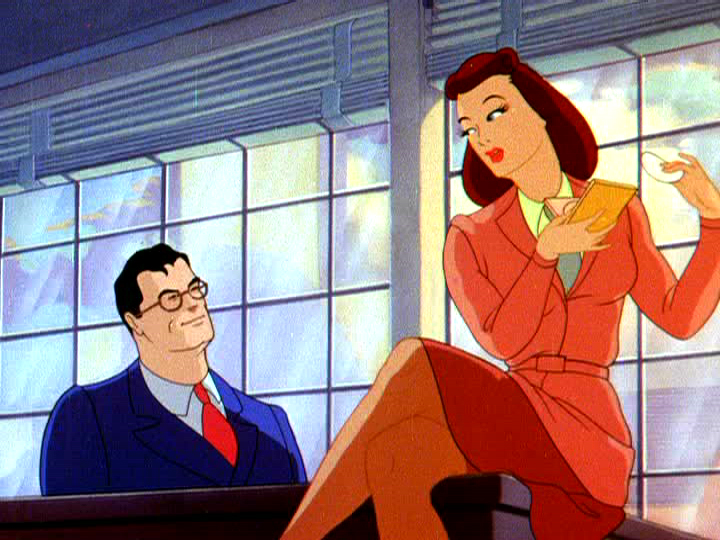
Werth:—I have a feeling I'm going to miss that old "comic book" sense of style that some earlier incarnations of Superman embodied. In 1941 producer Max Fleischer of Popeye fame and his brother, director Dave, brought the Superman comic books to the big screen in an animated short-form format for Paramount.
This was the Golden Age of the animated short, when Bugs, Mickey and Tom & Jerry delighted movie going audiences between feature films and Movietone News segments that showed Europe dissolving into war. They gave the audience time to breathe in between Citizen Kane, Suspicion, and Hitler.
Wise: And made it even harder to sneak out to the john.
Werth: But with the Superman series, the Fleischers did something a little more elegant than the other cartoons. Sticking to the comic's origin story, these shorts quickly absorbed the audience into the story of Superman, the last survivor of a doomed planet who has super powers like being faster than a speeding bullet and the ability to leap tall buildings in a single bound.
When he isn't fighting for truth and justice, he is disguised as mild-mannered reporter Clark Kent whose competitive relationship with deep-throated co-worker Lois Lane will undoubtedly lead to romance.... someday.
Wise: Lois put up a better fight than Hildy Johnson.
Werth: What makes these simple cartoons so thrilling is the animation that was used. The comic book becomes cinema with art moderne and industrial designs for everything from a radio, to a cityscape, to a huge death ray; and a film noir lighting scheme that uses shadows and light to rival The Maltese Falcon.
Shot in Technicolor, Lois Lane's salmon jacket and skirt are muted yet bold, and the way the figures move is mesmerizing with their jerking, yet fluid movement. Eight of the original cartoons are worth a gander with Superman fighting various mad scientists, a thawed-out tyrannosaurus rex, and a big ape who runs amok on the midway.
The robots in The Mechanical Monsters clearly inspired the robots used in 2004's Sky Captain and the World of Tomorrow, proving that even a 72-year-old cartoon can still inspire today's filmmakers.
Wise: The Adventures of Tintin (2011) is based on the beloved comic by Belgian artist Hergé and follows the intrepid young reporter (Jamie Bell) and his dog Snowy as they delve into the mystery surrounding a family curse, a valuable ship model and a sunken treasure. Combining three Hergé books—The Crab with the Golden Claws, The Secret of the Unicorn, and Red Rackham's Treasure—the film is a madcap frenzy of chase sequences, slapstick humor, and derring-do, taking full advantage of the combined talents of director Steven Spielberg and producer Pater Jackson.
Werth: That's a lot of talent.
Wise: The film was animated using motion capture and does so much more successfully than other projects which have used the technique and rendered their actors as a pack of creepy Botoxed mannequins.
Werth: It's like being sucked into an all-day Housewives of Beverly Hills Marathon on Bravo.
Wise: The technology allows Spielberg to indulge in every action sequence daydream he's had for the past four decades. Tintin is not bound by the same physics as Indiana Jones, and as a result doesn't simply evade a boulder or weather a nuclear blast in a refrigerator;
instead Spielberg stages a chase sequence that involves a jeep, a motorcycle, tumbling buildings, a tank, the torrent rushing from a dam, a trained falcon, a clothesline, a crowded bazaar, and a hijacked ship making its way out to sea.
Werth: And all of it unleashed in 3D.
Wise: The one element lacking is the emotional heft characteristic of even Spielberg's most lighthearted fare. It's difficult to say if this is the fault of the format (although Jackson's Weta Digital seamlessly marries Hergé's elegant line with incredibly realistic detail) or the cheerful blankness of the film's everyman hero.
Andy Serkis is both comic and touching as Tintin's tipsy but stouthearted ally Captain Haddock, and even Daniel Craig's sinister Sakharine has more emotional range. But even if the film doesn't make audiences cry, it can still make them cheer, which is quite an accomplishment for a comic book thrown onto the screen.
Werth: I'm ready to see if Zack Snyder can make me cheer.
Wise: At least as much as you cheered for the giant, blue, naked guy in The Watchmen.
Werth: Tune in next week for more big screen heroes right here on Film Gab!
Werth: You know what, Wise?
Wise: What's that, Werth?
Werth: I'd really like to thank the Acadamy.
Wise: Because they like you, they really like you?
Werth: No, because the Oscar telecast finally recognized Oscar losers. I'm not gonna say that host Seth MacFarlane and Kristin Chenoweth stole our idea, but we have mined this territory twice before.
Wise: It seems Mr. MacFarlane did a lot of things to ruffle people's feathers at the Oscars.
Werth: One person who must have been super ruffled was legendary film director, Steven Spielberg. His hugely successful bio-pic Lincoln lost Best Picture and, more surprisingly, Best Director.
Wise: And not just because historical bio-pics are usually a shoo-in at the Academy Awards.
Werth: But Spielberg might be used to losing Oscars on his slavery-themed movies. The Color Purple (1985) was famously nominated for 11 Oscars and lost every single one. But perhaps less remembered is Spielberg's cinematic treatment of a group of Africans who escape a slave ship in 1839, only to be put on trial here in America, Amistad (1997). The film was nominated for four Oscars and lost them all.
Wise:Most of the gold that year went to another film about an ill-fated ship.
Werth: Amistad is based on the true story of a group of Africans who are kidnapped and sent to Cuba before rising up against their captors, slaying them, and then trying to steer their boat home. Unfortunately they wind-up off Long Island, and are soon in shackles again for murder.
They become the center of an international property dispute that quickly leads to Presidential involvement due to the case's ramifications to American slavery. It's the sort of epic human issue canvas that Spielberg loves to paint on.
Wise: Munich, anyone?
Werth: The film veers between heavy-handedness, perceptive humor and stark, shocking realism, but the real joy in this film is to watch the performances. Morgan Freeman gives his typical charming and noble turn as freed slave Theodore Joadson, and Matthew McConaughey is spunky and eager as the defense attorney for the Africans, Roger Sherman Baldwin.
But the two standouts are Djimon Hounsou as Cinque and Anthony Hopkins as former president John Quincy Adams. Hounsou is a revelation, his imposing screen presence a mix of sheer physical size, vocal roar, and intensity.
Hopkins works magic by throwing himself whole hog into this addled and rickety, irascible and brilliant man. The scene where we first see Adams "napping" in Congress is textbook perfection of how to introduce a character with only a simple shot and one line of dialogue.
Hopkins lost the best Supporting Oscar to Robin Williams in Good Will Hunting and Spielberg wasn't even nominated. So my guess is Spielberg will avoid slavery flicks for a little while.
Wise: Perhaps there's no better example of an Oscar loser than Bette Davis in Of Human Bondage (1934). Based on the novel by W. Somerset Maugham, the film also stars Leslie Howard as Philip Carey, a club-footed aesthete who abandons his dream of studying art in Paris and returns to study medicine in London where he falls for cockney waitress Mildred (Davis). He lavishes attention on her, but she prefers the company of wealthier men who enjoy life's rowdier pleasures and aren't burdened by a dysfunctional leg.
Werth: I'm with ya' Mildred.
Wise: Mildred runs off with another man, but comes back destitute and pregnant. Philip takes her in, but just as she makes it back on her feet, she runs off again beginning a cycle that results in both spiraling out of control. Along the way, Philip finds comfort in the friendship he develops with a patient (Reginald Owen) and his daughter (Frances Dee).
Werth: But Mildred's more fun.
Wise: This was the picture that made Davis' career. She had been laboring in smaller films at Warner Bros., but when Bondage director John Cromwell caught of preview of one of Davis' performances, he insisted on borrowing her for the film. Legend has it that the Warner brass was happy to have the tempestuous actress off the lot for a few weeks, but were furious when their contract player was transformed into a star by another studio and quietly encouraged the Academy not to nominate Davis.
A furious write-in campaign erupted, but despite the best efforts of her peers, Davis still lost the Oscar to Claudette Colbert for It Happened One Night. Still, Davis is magnificent playing both the slatternly Mildred and Philip's fantasy vision of her: tender, compliant, virginal in softly-lit, frothy white dresses. She even gets an incredible breakdown scene where she rages at Philip's impotence and later almost destroys his chances of finishing medical school.
Werth: No actress has ever done as much with the line "Wipe my mouth."
Wise: It's really an amazing performance, full of vibrance, passion, and wit.
Werth: Which is more than I can say for this year's Oscars ceremony.
Wise: Perhaps next year we can host— but until then, check in next week for more Film Gab!
Wise: Ahoy, Werth!
Werth: Um, hi, Wise. What's with the yachtsman's cap?
Wise: I went sailing with my parents last week and I've been feeling pretty nautical ever since.
Werth: Does this mean that you've been making tuna noodle casserole for dinner?
Wise: No, but it does mean that I'm itching for cinematic adventures on the high seas.
Werth: Ooh! Set sail, Cap'n Wise! Set sail!
Wise: The Life Aquatic with Steve Zissou (2004) emerged from Wes Anderson's deep affection for Jacques Cousteau's oceanic travelogues, and it follows the title character's (Bill Murray) faltering career as an undersea documentarian and the comic misadventures that unfold as he pursues both a relationship with the son he abandoned (Owen Wilson) years before and revenge upon the fabled jaguar shark that made a fricassee of his best friend.
Werth: Is the jaguar shark part fish, part cat?
Wise: The Life Aquatic is perhaps Anderson's most whimsical film. Always a writer/director with a very specific point of view, Anderson allows his boyhood fancies to drive this film closer to fantasy than any of his other work. Of course his usual preoccupations are on full display—strong mothers and absent fathers, the dreamer battered by experience, densely layered set and character design—and they mix with the outlandish elements with varying degrees of success.
There's a marvelous image of Anjelica Huston lying dreaming in an underwater observation pod, while the final encounter with the elusive jaguar shark seems freighted with undecipherable meaning.
Werth: It's totally undecipherable. How would a jaguar be able to hold its breath long enough to mate with a shark to make jaguar shark babies?
Wise: I have to admit that Aquatic isn't my favorite Anderson film, although it does reward repeated viewings. It's always interesting to watch a filmmaker reach beyond his usual concerns, plus the shaggy nature of the movie allows for for some standout performances, including Cate Blanchett as the kind of tough-talking yet vulnerable girl reporter Katherine Hepburn might have played, and Michael Gambon as Zissou's silver-tongued producer on the lam.
Also of note is the gorgeous undersea menagerie designed and animated by Henry Selick. But it's the central performances from Murray and Wilson as the mountebank and his guileless offspring that really makes this movie set sail.
Werth: Now that you've gotten me obsessed with sharks, I can't help but talk about the best shark/sailing movie ever, Jaws (1975).
Wise: If only The Poseidon Adventure had starred a Great White.
Werth: Based on Peter Benchley's hit book, Steven Spielberg's Jaws swam into theaters June 20, 1975, and officially originated the Hollywood Summer Blockbuster. With nothing but a couple small films and TV under his belt, Speilberg created a national sensation with this movie about a lone shark rampage in the waters off sleepy Amity Island on Fourth of July Weekend.
People all over the country mimicked John Williams' Oscar-winning, iconic main title and, "You'll never go into the water again," became a national catchphrase that caused as much H2O aversion as Hitchcock's shower scene in Psycho.
Wise: I haven't showered within sight of the shoreline since I could press "Play" on the Betamax.
Werth: While its terror factor is off the charts, Jaws is also, at its heart, a male, sail-bonding adventure. Chief Martin Brody (Roy Scheider), Sam Quint (Robert Shaw) and Matt Hooper (Richard Dreyfuss) hunt the killer shark in Quint's small boat, The Orca, and work together on the empty to ocean to destroy this awesome beast. It is through this shipboard interaction that their layered characters emerge—most profoundly with Quint's mesmerizing "USS Indinapolis" monologue.
These scenes of camaraderie on the ocean make what could have been just a fishy monster film a much richer dramatic experience. It was a methodology that Spielberg would utilize on successive films to make popular movies and a boatload of money.
Wise: I wouldn't mind setting sail in just a dinghy full of cash from Spielberg's boatload.
Werth: Well, sailor, in the meantime you and our readers should just hoist the misenmast on the S.S. Film Gab!