Showing posts with label Rope. Show all posts

Friday, June 28, 2013

Hitch-Hitch Hooray!

Werth: Good, Eefning.

Wise: Nice Hitchcock impersonation, Werth.

Werth: Thank you.

Wise: Especially the double-chin.

Werth: I'm not wearing a double—yes, thank you. I'm wearing this clearly fake double-chin in honor of BAM's The Hitchcock 9, starting tomorrow.


Wise. They will be showing nine restored Hitchcock silent films giving Hitch aficionados the chance to see some of the master's earliest work.

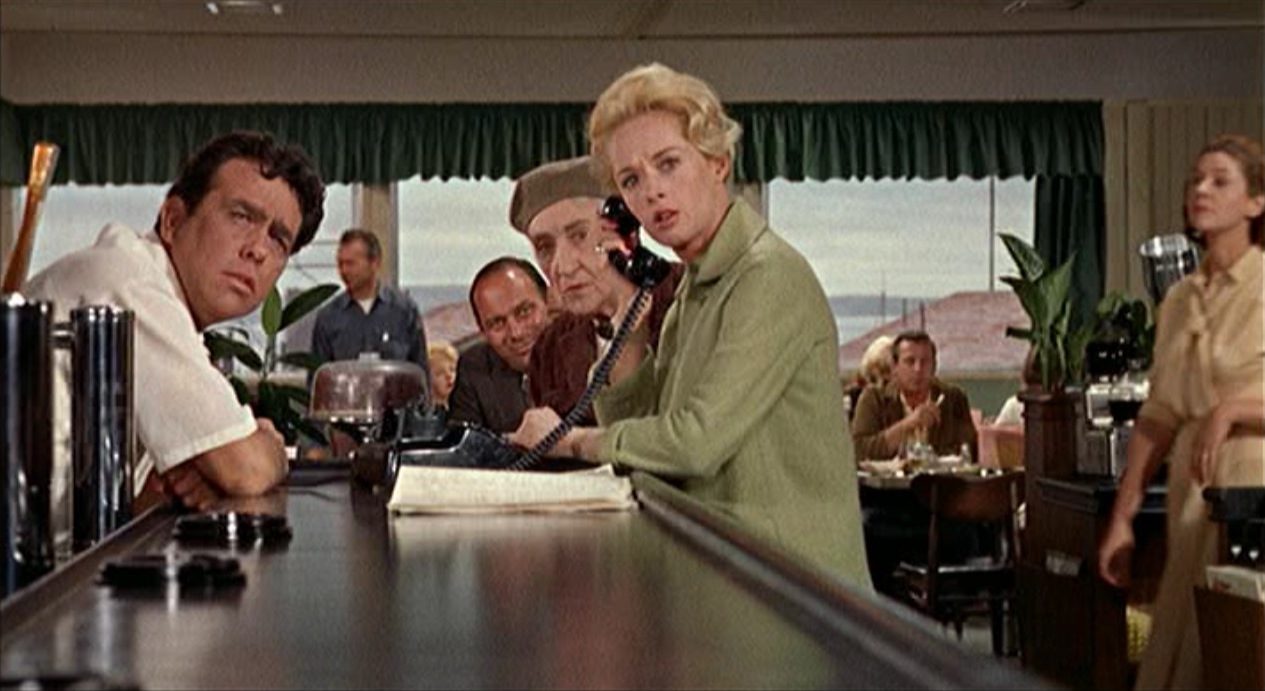
Werth: We've covered many Hitchcock films over the last couple of years, but one Hitchcock film I've always wanted to gab about is his 1963 feather-fest, The Birds.

Wise: I hope you weren't too chicken to do it before. 

Werth: The Birds is a genuinely terrifying film that shows what would happen if Nature turned against her human oppressors and pecked out mankind's eyes. 
But I don't think that's what The Birds is really about. The more I watch the film, the more I notice how the environmental angle comes up quite late in the film, and that a good part of the film is focusing on something else—sex.

Wise: Sounds like we need a double feature of The Birds and Killer Bees.

Werth: The entire first part of the film has nothing to do with crazed seagulls. Melanie Daniels (introducing Tippi Hedren) is a blonde, debutante phony. After pretending to be a salesgirl in a bird shop to flirt with g-gorgeous Mitch Brenner (60's heartthrob Rod Taylor), Daniels decides to pursue this virtual stranger to his seaside country home to give his daughter a couple of lovebirds. 
As Daniels drives her expensive sportscar into the rustic town of Bodega Bay the townspeople gaze at her with distrust. This stranger isn't just a fur-clad city-girl in the country. She is a woman doing the unthinkable: she is chasing the man. Daniels' sexual aggressiveness is as garish as the two lovebirds in her car and Hitchcock slyly shoots the first part of the film to accentuate how unwelcome Daniels is. After sneaking into his house and dropping off the birds, causing Brenner to chase her, Daniels grins like a cat, sensing she has snagged her romantic prey. 
It is at this moment that the first bird dives at her head, drawing blood. From this moment on Daniels is not only being attacked by Bodega Bay's birdlife, but also Brenner's stuffy mother (Jessica Tandy) and the citizenry who tell her she is "evil."

Wise:It doesn't pay to cross Miss Daisy. 

Werth: But film analysis aside, Hitchcock is in top thriller form in The Birds. He uses his signature camera tricks of characters in the foreground, hallways that create a forced perspective, and an ingenious bird's eye view of the destruction of Bodega Bay care of Oscar-nommed special effects director Ub Iwerks. 
He takes great delight in making the audience aware of the dangers that the film's characters are not aware of. You just want to shout at Tippi, "Get off that bench and run before those crows mess up your impeccable hair!!!" 
And the sound design by Remmi Gassmann is eerie, achieving all its impact without a single note of orchestration. While it's never mentioned with the same gravitas as Vertigo or Psycho, The Birds is memorable because Hitchcock was exploring so much more than screaming kids being attacked by some peck-happy fowl.

Wise: Rope (1948) is another Hitchcock project where sex is the subtext.  Inspired by thrill killers Leopold and Loeb, the film begins with the murder of golden boy David Kentley (Dick Hogan) by his former classmates Brandon Shaw (John Dall) and Phillip Morgan (Farley Granger) who are out to prove that their intellectual superiority allows them to commit the perfect crime.  Before disposing of the body—and to add a grisly embellishment—they plan a party with the dead man's parents and fiancĂ©e as well as with their former prep school housemaster Rupert Cadell (Jimmy Stewart).  
Brandon has always idolized Rupert who taught the boys about Nietzsche's theories, and by committing the murder, Brandon hopes to intellectually surpass his mentor.  The scheme only falls apart as Phillip gradually loses his nerve.  

Werth: It's hard to sit on a trunk containing a corpse and not sweat a little.

Wise: The action unspools in real time, and Hitchcock used long takes carefully edited together to simulate a single continuous take, the camera moving among the actors and the set in a complicated ballet that allows the tension to build to an almost unbearable extreme.  These extended shots also allow the actors space to explore their character's body language, moving in and out of the frame while still being present in the scene.   
Rope was also Hitchcock's first color film, and he uses his palette carefully, confining himself mostly to muted grays in the beginning as Brandon and Phillip attempt to convince each other of their rationality, but descends into lurid neon flashes as the horror of their act comes to light.

Werth: I love how Stewart toys with his old students. It's almost as if he knows from the moment he walks into the room that there's something in that hope chest...


Wise: Although the focus of the film is on a single murder, it films much closer to a movie about a lovers' quarrel.  
Brandon and Phillip stand uncomfortably close to one another and speak in a post-coital whisper, particularly in the moments just after they have committed the murder and dissect their feelings (Brandon is exhilarated while Phillip suffers from regret).  Even the practicalities of their daily lives are peculiarly intertwined; Brandon treats Phillip as a sensitive genius, managing his career as a pianist and carefully tending to his emotional outbursts.  
The thorn in their relationship comes with the arrival of Rupert who not only teases out the crime but also inspired it with his lofty talk of philosophy.  Brandon has obviously harbored a long-standing fascination with his former housemaster that festered into the kind of one-upmanship usually reserved for past lovers.  But it's this fascination twisted into obsession that finally unravels the crime. 

Werth: So, Wise, with all this gabbing about color Hitchcock films, I hope our devoted readers check out some of his black and white fare.

Wise: And neither killer birds nor murderous aesthetes will keep them away from next week's Film Gab.


Friday, May 6, 2011

The Big Screen in the Sky

Yesterday we bid adieu to one of the great play and film scribes of the 20th Century. Arthur Laurents began writing for Broadway in 1945, quickly transitioning to Hollywood with 1948's Hitchcock classic, Rope. Laurents successfully straddled both coasts by parlaying his landmark stage successes West Side Story (1961) and Gypsy (1962) to the screen as well as writing cinematic gems like Summeritme (1955), Anastasia (1956) and The Way We Were (1973). Known for being blunt about his sexuality and his opinions about how Hollywood mangled his stage successes, Laurents was passionately outspoken about his work and was even the target of the Great Communist Hunt of the 1940's for his work with civil rights causes. Today we hope that Heaven is a-buzz with the argument, "Which is better? West Side Story the musical or the movie?"

Tuesday, March 29, 2011

Big Screen in the Sky

Actor Farley Granger died yesterday in Manhattan at age 85. Granger came to prominence in 1948 in Alfred Hitchcock's disturbing re-telling of the Leopold and Loeb murder case, Rope. Legendary for its camerawork (it was composed of just ten shots) Rope also was noteworthy for its homosexual murderous duo. While Granger nor his co-star John Dall ever speak of the love that dare not speak its name, the film sizzles with an underlying attraction and dependence between the two young men. Hitchcock would use Granger again in the center of a strange mano-a-mano pairing in 1951's Strangers on a Train. In Strangers, Granger strikes up a bizarre relationship with Robert Walker when Walker's sociopathic, and strangely effete character takes Granger up on an offer to kill someone for him. Granger is surprised to learn that a conversation he thought was simply a lark becomes a deadly case of prid pro quo. As with Rope, there is an underlying tone of homosexuality, that if fully expressed would have doomed the movie's script to the garbage can. But thanks in good part to Granger's performances, the subtexts can be read and enjoyed by those who wanted to read between the lines. It probably didn't hurt that Granger was a self-professed bi-sexual who wooed the likes of Shelley Winters, Leonard Bernstein and Arthur Laurents. While not necessarily out and proud, Granger certainly gave a face to a different kind of male lead in 1940's Hollywood.