Wise: Hello, Werth.
Werth: Bonjour, mon gabber. Comment ça va?
Wise: I think you have some croissant stuck in your teeth.
Werth: No, I just saw Wes Anderson's Moonrise Kingdom.
Wise: In French?
Werth: I was just struck by how stylistic Wes Anderson's work is, and how he could be considered a modern auteur director.
Wise: And since French critics like Francois Truffaut came up with the auteur theory in the 1950's, you started speaking Gallic-ly.
Werth: Très bien. While not everyone buys into the auteur theory (yes, Pauline Kael, I'm talking about you), what Truffaut and his ilk sought to do was to discuss certain directors' bodies of work by highlighting the visual and stylistic similarities in their films. Originally they used the auteur theory to define Hitchcock, Hawks, Kurosawa and others.
Wise: But the theory works equally well with contemporary directors, many of whom were just as influenced by the Cahiers du Cinéma crowd as they were the films they discussed.
For instance, Ang Lee who has genre-jumped memorably throughout his career— the domestic drama of The Ice Storm (1997); screwball mix-ups in The Wedding Banquet (1993); martial arts thrills in Crouching Tiger, Hidden Dragon (2000); and even superhero blockbuster Hulk (2003)—still puts his stylistic stamp on everything he does.
Werth: I'm just glad he got Heath and Jake naked in Brokeback Mountain (2005).
Wise: While Lee's films are all deeply interested in character, I'd say that his style is most evident in the careful way he uses image to communicate the delicate balance between reason and emotion. And nowhere is that more evident than in his adaptation of Jane Austen's Sense and Sensibility (1995). Working from an Oscar-winning script written by his star Emma Thompson, Lee takes Austen's premise of two sisters and their very different love affairs and uses it to explore his own fascination with estrangement and constraint and the ways in which they both can be shattered by passion.
Werth: And bonnets. Lots of bonnets.
Wise: Banished from their home by the vagaries of British entitlement, sisters Elinor (Thompson) and Marianne (Kate Winslet) Dashwood retire to a remote cottage with their mother and younger sister Margaret. The seclusion only heightens the sisters' natural tendencies—Elinor to circumspection; Marianne to passion—and colors their interactions with potential suitors.
Werth: Although sadly there is no gravity-defying, kung fu swordplay.
Wise: The film is full of dualities: will Marianne choose the dashing Willoughby (a very sexy Greg Wise) or the more restrained Colonel Brandon (Alan Rickman)?; will Elinor rely on decorum or will she toss it aside in pursuit of true love (a remarkably stutter-free Hugh Grant)? Lee delights in these choices and dramatizes them onscreen.
He and cinematographer Michael Coulter carefully compose each shot, but often disrupt the harmony with turbulence, whether with a fluttering curtain, a jagged hedgerow, or Marianne's frantic dash across the hillside. While seeming unobtrusive, his camera moves pointedly reveal character, confining Elinor's suffering to a corner of the frame while Marianne's theatrics devour the screen.
But perhaps most characteristic of Lee's work is his use of the sky—rumor persists that he insisted on expensive CGI clouds to perfect a single shot—to express his characters' aspirations and to signal the emotional tenor of a scene. His sensitivity, tempered by rationality, infuses each of his films with not only a distinctive look, but also a set of themes that makes his work instantly recognizable and deeply personal.

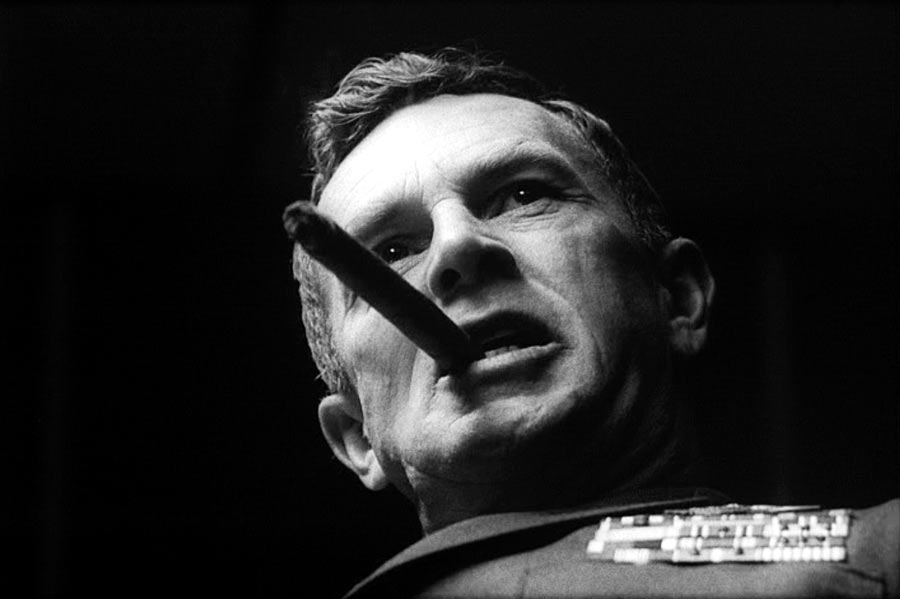
Werth: A director that many consider to be a good candidate for auteur status is Stanley Kubrick. Throughout a wide range of film genres, Kubrick's films have a distinct visual style and viewpoint that make his work unmistakeable. One of his most popular films is 1964's long-titled Dr. Strangelove: Or How I Learned to Stop Worrying and Love the Bomb. Originally conceived as a thriller based on Peter George's Red Alert, Kubrick's re-writes of the script kept getting funnier and funnier. So he decided that the best way to communicate his dark theme of nuclear detente was through satire, and, with writer Terry Southern's help, he soon had a hilarious dark comedy script to shoot.
Wise: I wonder if Battleship began as a thoughtful examination of nuclear responsibility?
Werth: A crazed general trips an alarm sending U.S. bombers to drop nukes on Russia starting a domino effect that insures the destruction of both countries and the world. Now just reading the plot, it's hard to find anything funny about it, but all one has to do is look at some of the character names to know that this movie has a wicked sense of humor.
Peter Sellers masterfully improvises three characters: Group Captain Lionel Mandrake, President Merkin Muffley and the ex-Nazi scientist Dr. Strangelove. George C. Scott chews up the scenery in the War Room as gum-chewing General Buck Turgidson. Sterling Hayden is the body fluid-obsessed commander of Burpelson Airbase, General Jack Ripper. Slim Pickens drawls his way onto a nuclear warhead as Major '"King" Kong. But Keenan Wynn really tips the comedy name scales as Colonel "Bat" Guano.
Wise: Clearly Kubrick should not name children.
Werth: Kubrick's genius with his dramatic material (like Full Metal Jacket (1987) and A Clockwork Orange (1971)) was to wrap his real world themes in dark, ridiculous comedy. He worked this idea of overlapping real and unreal into how he shot his films as well. The opening scene is visual poetry with the credits appearing over stock footage of a mid-air plane re-fueling that winds up looking like plane sex to the tune of "Try a Little Tenderness."
Fantastical sets like the War Room are shot under high, focused, overhead lighting to give a sense of realism (much like his use of candlelight in Barry Lyndon (1975)).
His use of handheld cameras for the assault on Burpelson gives a documentary style to the action, but his very long takes and static, often dramatic, camera angles for other scenes create a striking cinematic effect (much like his long tracking shots using a Steadicam in The Shining (1981) and Eyes Wide Shut (1999)).
His attention to details like cockpit checklists and phone conversations is so precise in its grasp of reality, that it makes a viewer wonder why the "boring stuff" wasn't cut-out of the movie.
That dual quality of being aware and at the same time not aware that you are watching a movie is a cohesive theme that resonates through all of Kubrick's films, making him an arguable example of the visual and thematic auteur director.
Wise: I wonder if Truffaut would think Film Gab was an auteur blog.
Werth: Tune in to Film Gab next week when we use a Ouija board and a French phrasebook to find out!
Wise: Happy New Year, Werth! How was your Christmas?
Werth: It was busy. I single-handedly re-vamped the FBI, shot a film with Laurence Olivier, and this weekend I become the first female Prime Minister of England!
Wise: It sounds like someone's been catching up on the bio-pics of 2011.
Werth: It's a bumper-crop of bio-pics this Oscar season with Leonardo DiCaprio as J. Edgar Hoover in J. Edgar, Michelle Williams as Marilyn Monroe in My Week with Marilyn, and Meryl Streep as Margaret Thatcher in The Iron Lady.
Wise: All three should compete in the Best Actress category.
Werth: Hollywood loves movies about famous people, and why not? Their stories are full of inspiration, real-life challenges, and strange accents—roles that actors and actresses love to sink their teeth into. And no one takes a juicier bite of history than George C. Scott in director Franklin J. Schaffner's Patton (1970).
Wise: From Maggie Thatcher to Old Blood and Guts. Is the testosterone increasing or decreasing?
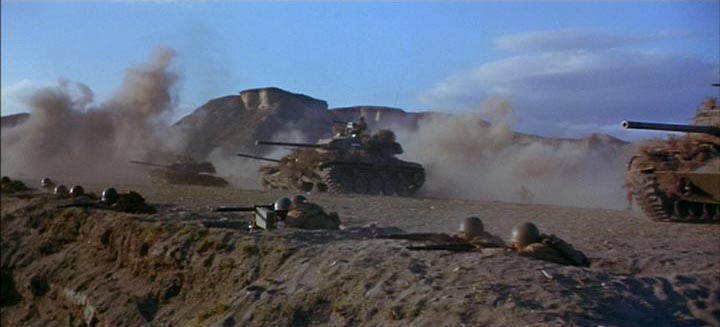
Werth: Patton is a bio-pic tailor-made for the man in all of us. Chronicling the WWII African and European campaigns of General George S. Patton, the film is an action-packed smorgasbord with well-choreographed battle scenes that thrill, but also remind us of the horror and indignity of war. The scope of the filming is epic with wide camera vistas, rousing score (by Oscar Goldsmith), and a three-hour running time complete with intermission.
Wise: Let's go out to the lobby, indeed.
Werth: But eclipsing all of that is Scott. His portrayal of Patton is so expertly transcendent that he even towers over the invasion of Sicily. Patton was a brilliant hardass who rallied his troops to do impossible feats in the midst of impossible circumstances. Scott stomps around with his riding crop and boots, spouting French and theories on reincarnation, scowling with a jaw of granite one moment then breaking into a cocky grin the next, making us willingly fall in line—even if we think he's a Napoleonic blowhard.

The iconic opening scene in front of an immense American flag perfectly encapsulates Scott's ability to horrify and charm his audience with a performance that defines the power of conviction. Scott doesn't make Patton human as much as he makes his legend real. And the film feels amazingly fresh in the context of our current wars and questions about the nature of patriotism. Patton won seven Oscars including best Director and Best Picture, but Scott refused to accept his statuette because he didn't feel actors should be in competition with each other. It's probably not a stance that the medal-loving George S. would have taken.

Wise: Although Elizabeth (1998) purports to be a biography of the most famous queen of England, it's really more of an historical fever-dream about the early reign of Queen Elizabeth I (Cate Blanchett). Director Shekhar Kapur began his career making Bollywood flicks and that frenzied, colorful style definitely influenced this film, transforming the traditionally staid British historical drama into something exotic. The film also catapulted Australian actor Blanchett to international stardom and provided a delightful bit of irony in having a native of a former colony playing The Virgin Queen.
Werth: Coincidentally, a role I often played when I first moved to New York.
Wise: Blanchett is terrific in the role. Bio-pics are uniformly about Overcoming Adversity and Achieving Success Despite the Odds, but Blanchett invests her performance with an amazing amount of subtlety despite all the drama swirling around her. Plus, she easily withstands the scenery-chewing supporting turns from the likes of Geoffrey Rush, Sir John Gielgud and Richard Attenborough. She is even able to overcome the elaborate period costumes which have swallowed up many a lesser actress.
Werth: I want a poisoned dress...
Wise: Quibblers can pick out the inaccuracies of the film, but in movies like these, slavish respect to the past is beside the point. They're all about big gestures, big set pieces and big emotions, but it's the truly good ones that transform all the pageantry into something real.
Werth: All this talk about 'big' makes me want to start work on a cheese dip for tomorrow night.
Wise: Tune in to next week's Film Gab to see how 'larger-than-life' we get. Happy New Year Everyone!