Werth: Howdy, Wise!
Wise: Shhhh! Not now, Werth. I'm trying to work on my juggling.
Werth: Auditioning for the Broadway revival of Pippin?
Wise: I'm trying to become a multi-hypenate. Right now, I think of myself as a baker-blogger and I'm hoping to add another accomplishment to the mix. All the big stars are doing it: Susan Sarandon, actress-activist-ping-pong-perveyor; Angelina Jolie, actress-ambassador-gossip-rag-staple; John Hamm, actor-comedian-trouser-enhancer.
Werth: And today's birthday boys show how much you can do with more than one talent. Both Dean Martin and Prince made their names as musicians before Hollywood came a-callin'. Martin went from Italian love songs to various Martin and Lewis comedies, to Some Came Running (1958) to Ocean's Eleven (1960).
Wise: And Prince's Purple Rain (1984) made the diminutive popstar a matinee idol... for at least two movies.
Werth: One of the biggest radio to movie stars would have to be Ol' Blue Eyes himself, Frank Sinatra. Starting with musical roles in Anchors Aweigh (1945) and On The Town (1949) Sinatra cannily worked his crooner persona onto the silver screen. But after multiple hits, he tried to become more than just a song and dance man and segue into a leading dramatic actor in From Here to Eternity (1953). In 1954, Sinatra starred in the low-budget thriller, Suddenly. It was not the doobie-doobie-doo character the audience was familiar with.
Wise: Swinging tunes for homicidal lovers.
Werth: Suddenly takes part in the small, California town of Suddenly, where nothing ever happens. Sheriff Todd Shaw (Sterling Hayden) keeps after war-widow Ellen Benson (Nancy Gates) for a more serious relationship while Ellen is busy trying to make her chippy son, Pidge (Kim Charney) realize that guns killed his dad, so he ought to shut-up about getting a cap-gun.
Wise: Sounds like the grim beginnings of A Christmas Story (1983).
Werth: Ellen's conflict with guns manifests itself when Johnny Baron (Sinatra) and a couple of goons take Ellen, the Sheriff, Pidge and Ellen's father-in-law (old-timer James Gleason) hostage and commandeer the Benson house. The living room is the perfect spot for a killshot, and the President is secretly coming into town on the five o'clock train.
Sinatra was known for being a bit of an unlikeable hero, and that persona would work well for him in From Here to Eternity, Guys and Dolls (1955) and The Man with the Golden Arm (1955), but in Suddenly, Sinatra takes a chance and plays a character who is without any sympathy. Johnny Baron is looney tunes, and no matter how many times Sinatra flashes his smile, it only makes the character less likable, and scarier. It's a great acting choice.
Wise: And reminds me of another great Sinatra performance.
Werth: The rest of Suddenly looks like a TV movie. Noir enthusiasts would say it's grainy. I say it's cheap, and other than Sinatra, the performances are uniformly 1950's Americana. But the plot has some fun turns and without spoiling the ending, I can say, who knew TV repairmen were so useful in thwarting Presidential assassinations?
Wise: Labyrinth (1986) stars another music to movie star David Bowie as Jareth the King of the Goblins who kidnaps the baby brother of Sarah (Jennifer Connelly) after she wishes the cherub would disappear. Despite the seductive gifts Jareth offers her, Sarah is determined to retrieve her brother and sets off to find the baby at the center of the titular labyrinth that surrounds Jareth's castle. To further impede her progress, Jareth sends the ill-tempered Hoggle (a puppet voiced by Brian Henson)
to lay a series of traps, but Sarah's kindness and determination to find her brother gradually wins Hoggle over and her joins her quest along with a series of other odd and endearing creatures she meets along the way. Eventually, Sarah must confront Jareth one-on-one in order to realize her power and save the day.
Werth: After the scene in the Farting Bog, I think Gas-Ex is the only thing to save the day.
Wise: The film emerged from a collaboration between Jim Henson and Brian Froud, after their previous project The Dark Crystal (1982) fell short of expectations. Labyrinth was designed to have more humor and be more relatable than Crystal, and went through several screenwriters penning multiple drafts before Henson and Stroud found the plot and tone they were looking for.
Bowie's involvement also necessitated some major changes to the movie; originally Jareth had been conceived as a more elusive figure, but with Bowie on board, the role expanded to allow the singer to perform several numbers as well as becoming both more antagonistic and more alluring to Sarah.
Werth: And include crystal ball juggling.
Wise: The film was a failure at the box office, but like many oddball kids' films of the era, has grown into something of a cult hit. It's not hard to see why the film wasn't warmly received during its initial release: audiences expecting the zany warmth of Henson's Muppets must have been deeply confused by Labyrinth's black humor and the squirm-inducing seductions performed by the adult Bowie on the adolescent Connelly.
Fans of Bowie must have been equally confused by the dilution of the musical chameleon's charisma by the overwhelming supporting cast of puppets. Still, there are many pleasures to the film—even its weirdness is something of a recommendation—making it definitely worth a second look.
Werth: I'm going to turn on Bowie's Rise and Fall of Ziggy Stardust album.
Wise: Whatever you listen to, tune in next week for more sounds and sights for Film Gab.
Wise: Hello, Werth.
Werth: Bonjour, mon gabber. Comment ça va?
Wise: I think you have some croissant stuck in your teeth.
Werth: No, I just saw Wes Anderson's Moonrise Kingdom.
Wise: In French?
Werth: I was just struck by how stylistic Wes Anderson's work is, and how he could be considered a modern auteur director.
Wise: And since French critics like Francois Truffaut came up with the auteur theory in the 1950's, you started speaking Gallic-ly.
Werth: Très bien. While not everyone buys into the auteur theory (yes, Pauline Kael, I'm talking about you), what Truffaut and his ilk sought to do was to discuss certain directors' bodies of work by highlighting the visual and stylistic similarities in their films. Originally they used the auteur theory to define Hitchcock, Hawks, Kurosawa and others.
Wise: But the theory works equally well with contemporary directors, many of whom were just as influenced by the Cahiers du Cinéma crowd as they were the films they discussed.
For instance, Ang Lee who has genre-jumped memorably throughout his career— the domestic drama of The Ice Storm (1997); screwball mix-ups in The Wedding Banquet (1993); martial arts thrills in Crouching Tiger, Hidden Dragon (2000); and even superhero blockbuster Hulk (2003)—still puts his stylistic stamp on everything he does.
Werth: I'm just glad he got Heath and Jake naked in Brokeback Mountain (2005).
Wise: While Lee's films are all deeply interested in character, I'd say that his style is most evident in the careful way he uses image to communicate the delicate balance between reason and emotion. And nowhere is that more evident than in his adaptation of Jane Austen's Sense and Sensibility (1995). Working from an Oscar-winning script written by his star Emma Thompson, Lee takes Austen's premise of two sisters and their very different love affairs and uses it to explore his own fascination with estrangement and constraint and the ways in which they both can be shattered by passion.
Werth: And bonnets. Lots of bonnets.
Wise: Banished from their home by the vagaries of British entitlement, sisters Elinor (Thompson) and Marianne (Kate Winslet) Dashwood retire to a remote cottage with their mother and younger sister Margaret. The seclusion only heightens the sisters' natural tendencies—Elinor to circumspection; Marianne to passion—and colors their interactions with potential suitors.
Werth: Although sadly there is no gravity-defying, kung fu swordplay.
Wise: The film is full of dualities: will Marianne choose the dashing Willoughby (a very sexy Greg Wise) or the more restrained Colonel Brandon (Alan Rickman)?; will Elinor rely on decorum or will she toss it aside in pursuit of true love (a remarkably stutter-free Hugh Grant)? Lee delights in these choices and dramatizes them onscreen.
He and cinematographer Michael Coulter carefully compose each shot, but often disrupt the harmony with turbulence, whether with a fluttering curtain, a jagged hedgerow, or Marianne's frantic dash across the hillside. While seeming unobtrusive, his camera moves pointedly reveal character, confining Elinor's suffering to a corner of the frame while Marianne's theatrics devour the screen.
But perhaps most characteristic of Lee's work is his use of the sky—rumor persists that he insisted on expensive CGI clouds to perfect a single shot—to express his characters' aspirations and to signal the emotional tenor of a scene. His sensitivity, tempered by rationality, infuses each of his films with not only a distinctive look, but also a set of themes that makes his work instantly recognizable and deeply personal.

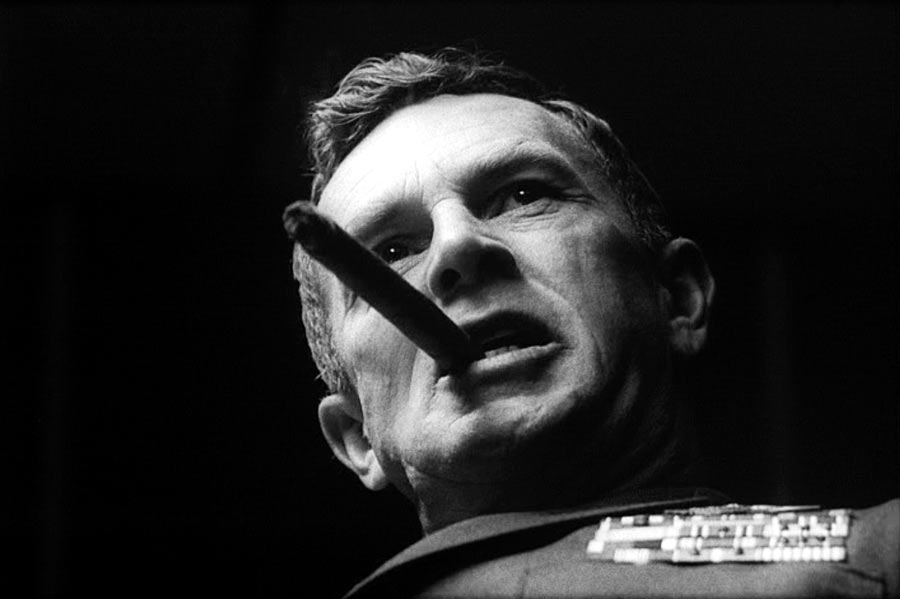
Werth: A director that many consider to be a good candidate for auteur status is Stanley Kubrick. Throughout a wide range of film genres, Kubrick's films have a distinct visual style and viewpoint that make his work unmistakeable. One of his most popular films is 1964's long-titled Dr. Strangelove: Or How I Learned to Stop Worrying and Love the Bomb. Originally conceived as a thriller based on Peter George's Red Alert, Kubrick's re-writes of the script kept getting funnier and funnier. So he decided that the best way to communicate his dark theme of nuclear detente was through satire, and, with writer Terry Southern's help, he soon had a hilarious dark comedy script to shoot.
Wise: I wonder if Battleship began as a thoughtful examination of nuclear responsibility?
Werth: A crazed general trips an alarm sending U.S. bombers to drop nukes on Russia starting a domino effect that insures the destruction of both countries and the world. Now just reading the plot, it's hard to find anything funny about it, but all one has to do is look at some of the character names to know that this movie has a wicked sense of humor.
Peter Sellers masterfully improvises three characters: Group Captain Lionel Mandrake, President Merkin Muffley and the ex-Nazi scientist Dr. Strangelove. George C. Scott chews up the scenery in the War Room as gum-chewing General Buck Turgidson. Sterling Hayden is the body fluid-obsessed commander of Burpelson Airbase, General Jack Ripper. Slim Pickens drawls his way onto a nuclear warhead as Major '"King" Kong. But Keenan Wynn really tips the comedy name scales as Colonel "Bat" Guano.
Wise: Clearly Kubrick should not name children.
Werth: Kubrick's genius with his dramatic material (like Full Metal Jacket (1987) and A Clockwork Orange (1971)) was to wrap his real world themes in dark, ridiculous comedy. He worked this idea of overlapping real and unreal into how he shot his films as well. The opening scene is visual poetry with the credits appearing over stock footage of a mid-air plane re-fueling that winds up looking like plane sex to the tune of "Try a Little Tenderness."
Fantastical sets like the War Room are shot under high, focused, overhead lighting to give a sense of realism (much like his use of candlelight in Barry Lyndon (1975)).
His use of handheld cameras for the assault on Burpelson gives a documentary style to the action, but his very long takes and static, often dramatic, camera angles for other scenes create a striking cinematic effect (much like his long tracking shots using a Steadicam in The Shining (1981) and Eyes Wide Shut (1999)).
His attention to details like cockpit checklists and phone conversations is so precise in its grasp of reality, that it makes a viewer wonder why the "boring stuff" wasn't cut-out of the movie.
That dual quality of being aware and at the same time not aware that you are watching a movie is a cohesive theme that resonates through all of Kubrick's films, making him an arguable example of the visual and thematic auteur director.
Wise: I wonder if Truffaut would think Film Gab was an auteur blog.
Werth: Tune in to Film Gab next week when we use a Ouija board and a French phrasebook to find out!