
Showing posts with label Barbra Streisand. Show all posts
Showing posts with label Barbra Streisand. Show all posts
Friday, February 24, 2012
We Had Faces Then...


Friday, February 17, 2012
The Good the Bad and the Gabby
Werth: Hello, Wise.
Wise: Oh, hi, Werth.
Werth: What's with the glassy-eyed gaze?
 Wise: This year I've been a little delinquent in my movie-watching, and I'm trying to catch up on all the big flicks I missed. But I have to admit that I'm feeling a little sideswiped by all the cute dogs, the sassy black maids, the steely ladies, the winking George Clooney-isms, the lifetime achievement awards disguised as supporting actor noms—and to top it all off, I just saw Shame.
Werth: Are you sure your vapors weren't brought on by seeing Michael Fassbender's bidness?
 Wise: Mr. Fassbender's anatomy has certainly become—justifiably—its own cause célèbre this awards season, but it didn't get him the best actor nomination that many were expecting.
 Werth: I expect he gets plenty of other rewards.
Wise: Undeniably. But it brings up a larger point—
Werth: His larger point always brings up.
Wise: —of movies that may have great performances—
Werth: Like Fassbender in bed.
Wise: —while the film as a whole just doesn't come together.
Werth: You make this too easy, Wise.
 Wise: Quit it.
In Shame, Fassbender plays Brandon, a thirty-something who works in a sleek Manhattan office and lives in an even more sleek highrise in midtown. He's also a sex addict. And has an emotionally needy sister named, conveniently, Sissy (Carey Mulligan) who turns up unannounced and creates havoc in his life by sleeping with his married boss and generally having spectacular breakdowns.
 Sissy's presence drives Brandon into violent rages, lugubrious melancholy, and ever more impersonal sex acts with strangers and prostitutes.
Werth: Which makes him no different from the average Frat guys hanging out down the block at Brother Jimmy's BBQ.
 Wise: Exactly. The camera loves Fassbender, and he delivers some virtuoso moments, but no matter how good he is in the role, the film's lack of depth sabotages his work. There's a vague allusion to his character's past, plus he has a discomforting familiarity with his sister (a shower scene almost as cringe-inducing as Psycho), but nothing that unlocks his agony for the audience.
 The director and co-writer of Shame, Steve McQueen, began his career as a visual artist, and that kind of attention to surface detail is everywhere apparent. Shame, at times, is a very beautiful film, but one that is not very deep.
 Werth: I don't know about you, but when I think of bad movies that are made better by a good actor showing a little skin, I think of Barbra Streisand in On a Clear Day You Can See Forever (1970).
Wise: Okay, that's not exactly what I was talking about, but I'll let it slide.
Werth: Clear Day was based on a middling Broadway show of the same name whose movie rights were bought up as Hollywood went nuts for musicals after My Fair Lady (1964) and The Sound of Music (1965) cleaned up at the box office. Unfortunately, Clear Day was not in the same league as these two cinematic cash machines.
 Clear Day tells the tale of professor cum hypnotherapist Dr. Chabot (Yves Montand) who inadvertently hypnotizes kooky student Daisy Gamble (Streisand) during one of his classes.
 Upon further sessions he discovers that Daisy has startling ESP abilities, can make flowers grow, and is the current incarnation of seductive Napoleonic Era social climber Melinda Tentrees (also Streisand) who the good doctor somehow falls in love with across time while Daisy falls in love with him.
Wise: I need someone to snap her fingers and wake me up from this plot.
 Werth: I won't even go into the myriad of complications like Daisy has a fiancee and a step-brother (Jack Nicholson—yes, Jack Nicholson in a musical) who has a yen for her or the fact that the university is having riots over these past-life experiments.
Wise: I'm surprised movie audiences didn't riot.
 Werth: They didn't, 'cause very few of them even saw the movie. But Streisand was a hot commodity. She'd just come off mega-hit Funny Girl (1968), and popular (though money-losing due to its over-sized budget) Hello Dolly (1969) and those performances seemed to propel her into Clear Day like she'd been shot out of a cannon. She's wonderfully quirky as chain-smoking, addle-brained Daisy and aggressively seductive as Melinda.
 The dining scene where she runs a wine glass along her ample, exposed cleavage makes one question the PG rating. And her voice is powerful, sure and emotive, tender one minute, fiery the next. "What Did I Have That I Don't Have" is a showstopper, and Vincente Minnelli pulls it off by focusing on Streisand in one room the entire song, his expertly mobile camerawork and blocking moving us through Daisy's indecision without making us feel like nothing's happening.
Wise: Sometimes I dream about being in a Minnelli tracking shot.
 Werth: Unfortunately no amount of Minnelli's skill and decorative visuals could reincarnate wooden leading man Yves Montand or this jumbled mish-mash of a musical. It would be Minnelli's final musical at a time when he and his work were becoming symbols of an old Hollywood that new Hollywood felt it had moved beyond. But like the plucky Daisy, Babs and her bosom would go on to thrive in that new world, continuing to live out many lives in front of (and behind) the camera.
Wise: I don't know about reincarnation, but I do know you and I will be coming back next week for more Film Gab!
Werth: Michael Fassbender comes back, too.
Wise: Oh, Werth...

Wise: Oh, hi, Werth.
Werth: What's with the glassy-eyed gaze?

Werth: Are you sure your vapors weren't brought on by seeing Michael Fassbender's bidness?


Wise: Undeniably. But it brings up a larger point—
Werth: His larger point always brings up.
Wise: —of movies that may have great performances—
Werth: Like Fassbender in bed.
Wise: —while the film as a whole just doesn't come together.
Werth: You make this too easy, Wise.

In Shame, Fassbender plays Brandon, a thirty-something who works in a sleek Manhattan office and lives in an even more sleek highrise in midtown. He's also a sex addict. And has an emotionally needy sister named, conveniently, Sissy (Carey Mulligan) who turns up unannounced and creates havoc in his life by sleeping with his married boss and generally having spectacular breakdowns.

Werth: Which makes him no different from the average Frat guys hanging out down the block at Brother Jimmy's BBQ.


Wise: Okay, that's not exactly what I was talking about, but I'll let it slide.
Werth: Clear Day was based on a middling Broadway show of the same name whose movie rights were bought up as Hollywood went nuts for musicals after My Fair Lady (1964) and The Sound of Music (1965) cleaned up at the box office. Unfortunately, Clear Day was not in the same league as these two cinematic cash machines.


Wise: I need someone to snap her fingers and wake me up from this plot.

Wise: I'm surprised movie audiences didn't riot.


Wise: Sometimes I dream about being in a Minnelli tracking shot.

Wise: I don't know about reincarnation, but I do know you and I will be coming back next week for more Film Gab!
Werth: Michael Fassbender comes back, too.
Wise: Oh, Werth...

Friday, January 13, 2012
Jazz Gab-ies
Werth: Hello there, Wise!
Wise: Oh, hi, Werth.
Werth: Why so glum? You weren't nominated for a Golden Globe?
Wise: No, it's not that. I always get a little blue this time of year. I took down the Christmas tree, all the holiday lights are disappearing, and the only things I have to look forward to until spring are whiskers on kittens and snowflakes that stay on my nose and eyelashes.
Werth: You mean you've been having your very own Julie Andrews film fest.
 Wise: I got a giant TV for Christmas; what else am I going to do with it? I've climbed every mountain, taken a parrot-headed umbrella out for a spin, and gone cross-dressing with James Garner. But one of my most enjoyable trips was a return to the Roaring Twenties of Thoroughly Modern Millie (1967).
Werth: Time travel with Julie Andrews. Sign me up!
 Wise: Playing Millie Dillmount, Andrews bobs her hair, gets a swank Jean Louis flapper wardrobe, and sets her cap for her handsome, but dim boss Trevor Graydon (the similarly handsome, but wooden John Gavin). Meanwhile, she becomes pals with beautiful orphan Miss Dorothy Brown (Mary Tyler Moore) who lives across the hall from Millie at the Priscilla Hotel for Single Young Ladies. At a dance hosted by the hotel's matron, Mrs. Meers (Beatrice Lillie), Millie and Miss Dorothy strike up a friendship with gadabout paperclip salesman, Jimmy Smith (James Fox).
 Werth: Don't forget the elevator that only works if you tapdance in it.
Wise: Oh, the whole film's a mess with crazy plot twists, ironic asides, mistaken identities, masquerades, unfortunate racial stereotypes, a
 white slavery ring, and Carol Channing as an oversexed society widow who dances on bi-plane wings, has a stable of lovers and belts a grab-bag of novelty tunes.
Werth: Nothing says entertainment like Carol Channing being shot out of a cannon .
Wise: Director George Roy Hill (Butch Cassidy and the Sundance Kid and The World According to Garp) keeps things moving cheerfully along, and screenwriter Richard Morris (The Unsinkable Molly Brown) sweetens his witty scenes with some great Tin Pan Alley confections, but attempting to make sense of the entire movie is nearly impossible.
 Audiences didn't seem to care about the lack of coherence when it premiered, and the film had an extended theatrical run that culminated in seven Oscar nominations. I'm not sure it deserves recognition from the Academy, but Millie is certainly full of delights.
 Werth: Well, Julie Andrews must have really enjoyed her trip back to the Jazz Age because a year later in 1968 she starred as 20's British actress Gertrude Lawrence in the musical bio-pic, Star!
Wise: Oh, hi, Werth.
Werth: Why so glum? You weren't nominated for a Golden Globe?
Wise: No, it's not that. I always get a little blue this time of year. I took down the Christmas tree, all the holiday lights are disappearing, and the only things I have to look forward to until spring are whiskers on kittens and snowflakes that stay on my nose and eyelashes.

Werth: Time travel with Julie Andrews. Sign me up!

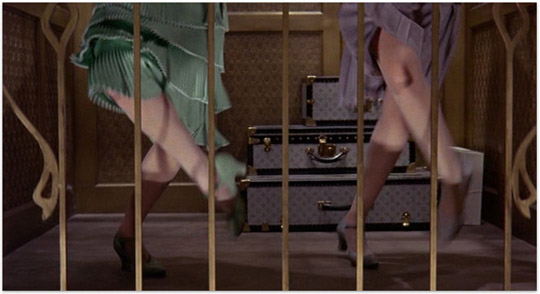
Wise: Oh, the whole film's a mess with crazy plot twists, ironic asides, mistaken identities, masquerades, unfortunate racial stereotypes, a

Werth: Nothing says entertainment like Carol Channing being shot out of a cannon .
Wise: Director George Roy Hill (Butch Cassidy and the Sundance Kid and The World According to Garp) keeps things moving cheerfully along, and screenwriter Richard Morris (The Unsinkable Molly Brown) sweetens his witty scenes with some great Tin Pan Alley confections, but attempting to make sense of the entire movie is nearly impossible.


Wise: Isn't Star! supposed to be a legendary flop?
Werth: It was—and at the risk of upsetting Julie-Heads everywhere, it deserved to be.
Wise: I can see the hate mail being delivered by angry airborne nannies now.

Wise: No one should ever overlook Streisand.


Wise: Was Julie's team too busy burnishing her adorability to bother reading her scripts?

Wise: You know that old adage about if you can't say something nice...?


Wise: I'm feeling a lot better after taking these two little detours in Julie's career—as long as we eventually get back to her playing magical nannies and lovestruck nuns.
Werth: Have one more spoonful of sugar with this little Julie web tidbit. Tune in for more supercalifragilistic cinema on next week's Film Gab.

Subscribe to:
Posts (Atom)