Showing posts with label Mary Tyler Moore. Show all posts

Friday, August 17, 2012

They're Baaaack!

Werth: One, two, three, four, five—

Wise: Are you practicing for your advanced math classes, Werth?

Werth: No, I'm counting the number of out-of-work action stars who are making a comeback in The Expendables 2.

Wise: You'll need an abacus for that.

Werth: While I'm not a huge fan of the mindless action genre, I think it's great that actors like Sylvester Stallone, Dolph Lundgren, Chuck Norris, Jean-Claude Van Damme and Arnold Schwarzenegger can put their golf clubs down and show up for hair and makeup.

Wise: The ones who still have hair.

Werth: That kind of comeback reminds me of my favorite star resurgence flick, What Ever Happened to Baby Jane? (1962).

Wise: Speaking of wigs and makeup.

Werth: When Robert Aldrich started pitching his cinematic take on Henry Farrell's novel, the studios were not biting. Not helping matters was the fact that the two stars of the film were stars in memory only. Neither Joan Crawford nor Bette Davis had much caché left at the box office after glorious careers as marquee headliners.
These famous leading ladies had been relegated to playing old baglady mothers (Davis as Apple Annie in Pocketful of Miracles (1961)) and ball-breaking bitch bosses (Crawford as Amanda Farrow in The Best of Everything (1959)). But after slashing the budget, Aldrich was able to convince Jack Warner to distribute the film, even if, as Warner was accused of saying, "I wouldn't give a plugged nickel for those two old broads."

Wise: I guess he was busy plugging other broads.

Werth: Baby Jane opens in 1917 in a vaudeville hall where the "Diminutive Dancing Duse from Duluth," Baby Jane Hudson (a sickeningly perky Julie Allred), taps and sings her way through her juvenile number, "I've Written a Letter to Daddy." An offstage tantrum reveals a rift between her and her older, un-famous sister Blanche (Gina Gillespie).
Fast forward to a screening room in 1935 where studio execs are screening the grown-up Jane in her latest flop (the footage is actually of Davis from 1933's Parachute Jumper) and wondering why they have to work with this hopeless has-been. The reason? Her hugely successful, movie star sister Blanche's contract requires that Jane get work too.

Wise: The drab older sister also rises.

Werth: But those tables turn again as a cinematically edited accident leaves us with the idea that the spoiled Jane has run over her sister with a car. The film then jumps again in time to the early 1960's where we find Blanche (Crawford) regally sitting in her wheelchair watching one of her old movies on TV (real footage from her hit Sadie McKee (1934)). Jane (Davis) tromps into the room looking like Mrs. Haversham after a mime class and the bitch-fest begins.
The great fun of this movie has always, and will always be the amazing chemistry between these two actresses. The sparks don't fly, they explode as Jane abuses Blanche and Blanche struggles to survive. Much was made in the press of how much Crawford and Davis hated each other, and perhaps that PR agent creation has colored our modern viewing of the film.
No one would be silly enough to say that these two titans of the silver screen liked each other, but by most reputable accounts they were nothing but professional on set. So that leaves us with two amazing actresses who were able to not only create unique opposing characters, but a complicated and emotionally engaging screen relationship with each other.


Wise: Which can't be said for those limp dishrags from Twilight.

Werth: Baby Jane is fascinating in that not only do we see a conflict between Davis/Jane and Crawford/Blanche, but Aldrich also seems torn between worshipping these old movie stars and degrading them. On the one hand we know their mythic reputations and get glimpses of their old work, but on the other, Davis transforms into a painful-to-look-at pyschotic harridan and Crawford is physically brutalized.
While neither actress came out of this movie "looking" good, Davis was nominated for an Oscar and both stars had a resurgence in their careers—even if it was made up of more horror schlock like Davis' Dead Ringer (1964) and The Nanny (1965) and Crawford's dalliances with William Castle in Strait-Jacket (1964) and I Saw What You Did (1965). Still, Baby Jane was a wonderful opportunity to remind the world that these two stars still had plenty of shine in them.

Wise: Even stars who haven't been eclipsed by the next generation sometimes need a career re-invention.  After two decades of being America's TV sweetheart, Mary Tyler Moore left behind the quirky world of sitcoms for Robert Redford's directorial debut Ordinary People (1980).  In it, she plays Beth Jarrett, a perfect suburban mother gone brittle and cold after the death of one son and the suicide attempt of the other.

Werth: That is definitely not a plotline for The Dick Van Dyke Show.

Wise: Based on the novel by Judith Guest, the film focuses on Beth's depressed son Conrad (Oscar-winning Timothy Hutton) and his attempts to return to normalcy despite the guilt he feels for not being able to save his brother in a boating accident.  Helping him along the way is psychiatrist Dr. Berger (Judd Hirsch gently stepping away from his smarmier Taxi persona) and his father Calvin (Donald Sutherland) who nobly, although fruitlessly, attempts to reconcile mother and son.

Werth: He should have just called in Lou Grant to take care of it.

Wise: Moore is terrifying in the role.  After years of playing appealing gals with spunk, she makes Beth utterly unapproachable—all jutting elbows, strained throat, pursed lips.  But unlike a lot of other actors' attempts at image reboots, Moore's past success actually enhances her work here. 
The warmth of her sitcom performaces throws her portrayal of Beth into greater relief, allowing her to make Beth colder and more vicious than just about any other actor could.  The audience longs for—along with her damaged, hurting son—the warmth of the person beneath this icy façade.

Werth: Icy façade or plastic surgery?

Wise: Redford's direction, aside from displaying great sensitivity to the subject, is very clever about the way he uses his actors.  After all, he was in the midst of transforming himself  from matinee idol to auteur, and cannily plays with audience expectations. 
Among other things, Ordinary People is about a golden boy who doesn't survive, and the scrappier, more emotionally messy sibling who does.  Redford uses that model for himself and his actors—especially Moore—escaping the gilded perfections of the past for a more complicated vision of the present.

Werth: Well faithful readers, make sure your complicated vision is focused on next week's Film Gab!


Friday, January 13, 2012

Jazz Gab-ies

Werth: Hello there, Wise!  

Wise: Oh, hi, Werth.  

Werth: Why so glum?  You weren't nominated for a Golden Globe?  

Wise: No, it's not that.  I always get a little blue this time of year.  I took down the Christmas tree, all the holiday lights are disappearing, and the only things I have to look forward to until spring are whiskers on kittens and snowflakes that stay on my nose and eyelashes.  

Werth: You mean you've been having your very own Julie Andrews film fest. 

Wise:  I got a giant TV for Christmas; what else am I going to do with it?  I've climbed every mountain, taken a parrot-headed umbrella out for a spin, and gone cross-dressing with James Garner.  But one of my most enjoyable trips was a return to the Roaring Twenties of Thoroughly Modern Millie (1967).  

Werth: Time travel with Julie Andrews. Sign me up!

Wise: Playing Millie Dillmount, Andrews bobs her hair, gets a swank Jean Louis flapper wardrobe, and sets her cap for her handsome, but dim boss Trevor Graydon (the similarly handsome, but wooden John Gavin).  Meanwhile, she becomes pals with beautiful orphan Miss Dorothy Brown (Mary Tyler Moore) who lives across the hall from Millie at the Priscilla Hotel for Single Young Ladies.  At a dance hosted by the hotel's matron, Mrs. Meers (Beatrice Lillie), Millie and Miss Dorothy strike up a friendship with gadabout paperclip salesman, Jimmy Smith (James Fox).  

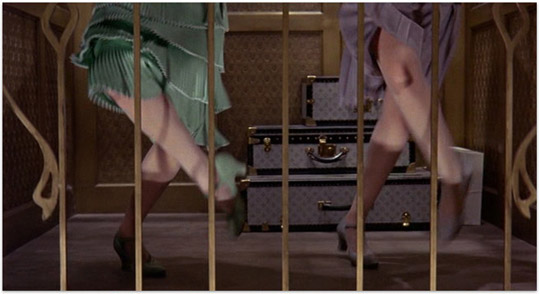
Werth: Don't forget the elevator that only works if you tapdance in it.  

Wise: Oh, the whole film's a mess with crazy plot twists, ironic asides, mistaken identities, masquerades, unfortunate racial stereotypes, a 
white slavery ring, and Carol Channing as an oversexed society widow who dances on bi-plane wings, has a stable of lovers and belts a grab-bag of novelty tunes.  

Werth: Nothing says entertainment like Carol Channing being shot out of a cannon .  

Wise: Director George Roy Hill (Butch Cassidy and the Sundance Kid and The World According to Garp) keeps things moving cheerfully along, and screenwriter Richard Morris (The Unsinkable Molly Brown) sweetens his witty scenes with some great Tin Pan Alley confections, but attempting to make sense of the entire movie is nearly impossible. 
Audiences didn't seem to care about the lack of coherence when it premiered, and the film had an extended theatrical run that culminated in seven Oscar nominations.  I'm not sure it deserves recognition from the Academy, but Millie is certainly full of delights. 

Werth: Well, Julie Andrews must have really enjoyed her trip back to the Jazz Age because a year later in 1968 she starred as 20's British actress Gertrude Lawrence in the musical bio-pic, Star!

Wise: Isn't Star! supposed to be a legendary flop?

Werth: It was—and at the risk of upsetting Julie-Heads everywhere, it deserved to be.


Wise: I can see the hate mail being delivered by angry airborne nannies now.

Werth: With the talent involved, it's actually quite shocking that the movie is as lifeless as it is. Robert Wise and Andrews had so much fun working together on The Sound of Music (1965), and since she owed 20th Century Fox another picture, it seemed like the perfect opportunity for the two to create yet another timeless musical classic. But they overlooked one thing—a hugely successful bio-pic musical starring Barbra Streisand called Funny Girl. 

Wise: No one should ever overlook Streisand.

Werth: Released in September of '68, Funny Girl beat Star! out of the gates by about a month with a very similar "came from nothing" story about an entertainer from the '20's (in this case, Fanny Brice) and racked up big box office and critical acclaim for its music and star. 
Unfortunately no matter how much love was banked for Andrews from her previous work, Star! was a critical and financial disaster that paled next to the competition. Andrews tried valiantly to be fresh-faced and plucky as the scene-stealing, temperamental ham Lawrence, but she was hobbled by forgettable tunes (with the exceptions of "Someone to Watch Over Me" and the theme tune) and a clumsy script conceit that had Andrews as Lawrence watching a movie about her life—alternating between faux newsreel footage and flashbacks.

Wise: Was Julie's team too busy burnishing her adorability to bother reading her scripts? 

Werth: The sytlized naturalness that made Andrews so appealing in other films doesn't work here, and Wise's direction is strangely uninspired. It's almost as if the concept of a "show musical" where the music emanates from a stage instead of exploding forth from human emotion and relationships traps Wise in ways that West Side Story (1961) and The Sound of Music freed him. 

Wise: You know that old adage about if you can't say something nice...?

Werth: Raymond Massey's son, Daniel is wonderfully wry as Lawrence confidante Noel Coward and earned an Oscar nom for his performance. But after all, he was Coward's godson—so he had to have picked up something. Donald Brooks was also Oscar nommed for his period costumes which ranged from Victorian street garb to spangled pajamas. Some of the musical numbers are so strange 
they are actually worth viewing. "Parisian Pierrot" has Andrews dressed as a harlequin; in "Limehouse Blues" she's an Asian callgirl stuck in the seedy part of old Chinatown; and for "The Saga of Jenny," Andrews croons in a staged circus wearing a glittery pantsuit. So on the whole, the film is worth watching—if nothing else to see how Star! earned its stripes as a classic Hollywood misfire.

Wise: I'm feeling a lot better after taking these two little detours in Julie's career—as long as we eventually get back to her playing magical nannies and lovestruck nuns.  

Werth: Have one more spoonful of sugar with this little Julie web tidbit. Tune in for more supercalifragilistic cinema on next week's Film Gab.