Friday, December 17, 2010

Momma & Poppa Can You Hear Me? Part Deux

Werth: So Wise, what did you think of Robert Osborne's interview with Liza on Turner Classic Movies?

Wise: Well, at first I was worried that someone had slipped me a mickey, but then I realized the focus was just incredibly soft.  

Werth: Not as soft as those layers of pancake makeup they were both wearing. 

 Wise: Liza has always impressed me with her ability to assess the talents and the failings of both her parents.  She’s respectful of their privacy, which maybe doesn’t allow film historians as much access as they’d like, but she’s also frank about the kinds of creative and personal pressures they were under.  She must understand that because, unlike a lot of celebrity children, her talents are on a level equal to those of her parents. What did you think?  

Werth: I think that the premise of showing her as the girl next door who puts on her flowing bell-bottoms one leg at a time just like the rest of us was misguided. We don’t watch Liza to see someone we could run into at Gristedes. We watch Liza to see her explode with quirkiness and lust for life in ways that only a Hollywood legend can. But it is nice to see her alive and kicking.

Wise: The interview did make me want to watch Cabin in the Sky which was her father's directorial debut and a film I had never seen before. 

Werth: I know it well. What did you think?

Wise: Well, for a long time, I had always thought of Cabin as the movie that used a couple leftover effects from The Wizard of Oz.  It was hardly ever shown on TV and a lot of the books I read praised it, but dismissed it as less important and less accomplished than Minnelli’s later work.  So I was surprised by how immediately engaging it is.
Werth: It’s really a primer to the whole Minnelli style.  You can see the root of all his fanciful touches, the decor, the costumes, the sweeping camera moves, and his two favorite motifs—mirrors and stairs.

Wise: Plus he’s already great with actors.  Before watching it, I had a dim feeling that Cabin, being an all-black musical from 1943, would be full of the regrettable stereotypes of the period.  And they are there, no question, but Minnelli clearly has such respect for both the actors and the characters  they’re portraying.  Ethel Waters and Eddie “Rochester” Anderson play a couple whose marriage nearly breaks apart because of his philandering and gambling.  Minnelli emphasizes their physical interactions—caresses, embraces, even punches—which gives the characters a heft they wouldn’t have had if another director, perhaps, had pushed the cartoonish eye-rolling and shuffling that was seen as comic during this time.  

Werth: It’s funny you should say that because when I saw Cabin in a film class this semester a number of the students were offended by it.  

Wise: Sure, there are a couple cringe-worthy moments, but I think that’s mostly due to some of the actors playing to type.  It was unavoidable at the time—Clark Gable had a type, Bette Davis had a type, Vincente helped create Judy’s type—but an actor playing to persona could sometimes allow for more creative risks.  
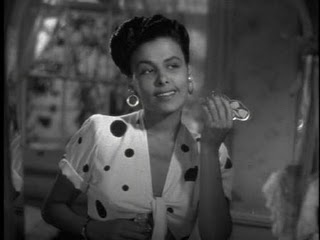
Werth: I know you don’t want to leave our discussion of Cabin without mentioning Lena Horne playing Georgia Brown, the bad girl temptress sent by the devil.  

Wise: Gorgeous, beautiful voice, funny, electric.  It’s just a shame that the culture didn’t allow us to see more of her talents on screen.

Werth: Since you’ve dealt so brilliantly with Vincente, I’m going to handle Judy.

Wise: Is that what Vincente said?

Werth: That depends which biography you’re reading.  But Wise, even though I hate to do this, I’m going to fly in the face of Werth & Wise tradition—

Wise: All four weeks of it?

Werth: I’m going to talk about… Television.

Wise: Should we change the name of the blog to Media Gab?

Werth: Hells no. We’re all aware how great Judy was on the big screen, but not everyone knows as much about her on the small screen. From 1963-1964 Garland hosted her very own musical variety show on CBS. Sunday nights opposite Bonanza, Judy would sing, dance, joke and chat her way through an hour-long entertainment extravaganza complete with guest stars and comic sidekicks.

Wise: Sounds a bit all over the place.

Werth: It was. The main problem was that the TV execs had no idea what to do with Judy. They tried giving her Dick Van Dyke’s brother Jerry to enhance the comedy. He wasn’t funny. They tried Judy serving “tea” to certain notable guests who would banter with her and tell stories. Censors yelled at her for touching her guests too much. They finally got on the right path when they decided to just turn the show into a weekly concert special where Judy would do what she did best—sing. But by then Judy was exhausted from a floundering marriage, the assassination of friend JFK, and the renewed influence of pills and white wine. So brand new CBS head honcho, Hunt Stromberg, Jr. (who’d never liked her to begin with) sent her a bouquet of flowers with the card, “You were great. Thanks a lot. You’re through.”

Wise: Ouch.

Werth: Despite all of that, Judy’s performances in these shows are, for the most part, marvelous. Her voice is powerful; her stage presence equal parts warm, charming and sad; and her interpretation of the songs insightful. She sings standards from her famous concerts and others like “Old Man River,” “Shenandoah” and a Porgy and Bess medley (with Vic Damone) that she would never have gotten the chance to sing in a movie. “Old Man River” in particular is so resonant with genuine pathos that you don’t question why this skinny white lady is singing a song written for a black man. Judy’s stint as a Hollywood laborer scarred her in a way that makes her performance of this song emotionally credible.

Wise: It always feels like she lived the lyrics of her songs.

Werth: True. True. But the shows aren’t all gloom and doom. The sets and the costumes have that early 60’s look. It’s a rare treat to see Judy perform with guest stars like Lena Horne, a tipsy June Allyson and ingenue Barbra Streisand. It’s a reminder how great the now-extinct variety show genre was.

Wise: If you want to bring the variety show back, we could start juggling flaming pins on the blog.

Werth: But then we’d have to change our blog name to The Werth & Wise Media Variety Hour.

Wise: Tune in next week for Film Gab with Werth & Wise.

Thursday, December 16, 2010

The Big Screen in the Sky

It's a very sad day here at Film Gab with the announcement of the death of writer/director Blake Edwards at age 88. It's impossible for this gabber to be subjective about Edwards. I was raised on The Pink Panther movies and had my first inklings of homosexuality while watching Victor Victoria. Later, as I began indulging in classic films, I came to appreciate his edgy drama The Days of Wine and Roses and of course his era-defining Breakfast at Tiffanys. Edwards' comedy came from an innate understanding of characters that were "fish out of water." Holly Golightly, Inspector Clouseau, Carole Todd and Peter Seller's hilarious lost Indian actor Hrundi V. Bakshi in The Party are all superb examples of characters who stayed true to themselves even in the midst of a normal, sometimes hostile world. It was life-altering to watch these films and realize that not being like everyone else could be funny instead of neurosis-inducing.
When Edwards was awarded an honorary Academy Award® in 2004, he rolled out onto the stage in an electric wheelchair. Hilariously, the chair malfunctioned and launched across the stage. Edwards grabbed his Oscar as he flew by the presenter and went through the wall on the opposite side of the stage. He couldn't even accept his Oscar®  like everyone else- and we wouldn't want it any other way. Heaven- Cue Mancini's "Pink Panther Theme", please.

Sunday, December 12, 2010

Thank Heaven for Film Forum!

If you're not doing anything too terribly exciting tomorrow night, why not stop by the Film Forum in New York City and say hello to classic Hollywood-French nymph Leslie Caron?
The star of such classics as Gigi (not to be confused with Gigli) and An American in Paris will be talking to film historian Foster Hirsch and signing her memoir Thank Heaven.
No puppets please.

Thursday, December 9, 2010

Momma & Poppa Can You Hear Me? Pt. 1

Here's a very special Film Gab "Don't Miss It!" Announcement:
The still-kickin' Liza w/ a Z will sit down with Robert Osborne of TCM for an interview about her legendary parents this Saturday 12/11 at 10PM and Tuesday 11/14 at 8PM.
Watch and we'll discuss...

There's No Place Like Home For The Holidays!

Werth: Happy Holidays, Wise!

Wise: Happy Holidays, Werth-- Wait, is it the Holiday Season already?  

Werth: I’m afraid so. 

Wise: How did that happen?  I barely made it through Thanksgiving and suddenly I’m expected to be buying gifts, sending cards, decorating trees, baking cookies, pretending to be jolly, and avoiding the crowds of tourists on the streets of Manhattan?  A fellow can only do so much.  

Werth: You’ll manage.  You were born to buy, send, decorate, bake, pretend and avoid. What are your plans for the holidays?  

Wise: You know how I roll whenever the calendar turns festive—beards, buggies, and shoo-fly pie.  I’m off to see my folks in Amish Country.  How about you?
Werth: I’m headed to the Land of Ahs for a couple days packed with family and corn.  

Wise: Something you just said made me a little queasy.  

Werth: It’s actually the perfect lead-in to this week’s films.  Full of schmaltz, conflict, navel gazing, angst, uncomfortable humor, dashed hopes—

Wise: Christmas dinner at the Lohan household?  

Werth: Movies about adult children returning home.  

Wise: Actually, one of my all-time favorite movies explores this very subject.  It’s called Judy Berlin—

Werth: Becky Prague?

Wise: Judy Berlin is about David Gold, a 30-something man who returns home to Babylon, New York after trying to make a go of it as a screenwriter in Hollywood.  He runs into a high school classmate—

Werth: Gina Barcelona.  

Wise: Judy Berlin played by Edie Falco just as The Sopranos was making her a star.  Her performance is energetic, wistful, a little bit naive, vastly different from the role of mobster’s wife that made her famous.  She’s about to leave for L.A where she hopes to become an actress and she takes her chance meeting with David as a good omen, but David wants to warn her that things might not turn out as well as she hopes.  Meanwhile, Judy’s mother—

Werth: Debbie London.

Wise: —Sue Berlin is acting out her frustrations with loneliness and her daughter’s leaving by having a flirtation with David’s father—

Werth: Morey Amsterdam.  

Wise: Arthur Gold, who’s the principal at the school where she teaches.  And Arthur feels thwarted in his own marriage to—

Werth: Katie Gstaad.

Wise: Alice, played by the magnificent Madeline Kahn in her final film role.  I know it’s a cliche to describe the performances of certain actresses of a certain calibre as luminous, but Kahn is spectacular in this movie.  An unexpected eclipse plunges the town into darkness, but she wanders the streets, caroling nursery rhymes and emitting a radiance that forces the other characters to confront their deepest disappointments. 

Werth: Sounds like one of those movies where’s there’s a lot going on, even though nothing happens. 

Wise: Kind of, but the tremendous acting carries through the lack of incident.  In addition to Falco and Kahn, Barbara Barrie is great as Judy’s mother, and so is Bob Dishy as the principal.  Plus it’s photographed beautifully in black and white and makes suburban Long Island into a kind of alien landscape.  I really can’t say enough good things about this film.  

Werth: Peggy Lisbon?  

Wise: Are you done yet?  

Werth: Are you frustrated yet?

Wise: Totally.  

Werth: Speaking of frustrated people who go to visit their families, I think we should talk about the grand-daddy “going home” picture of them all, Cat on a Hot Tin Roof.

Wise: Oh that’s a good one.

Werth: It’s such a goodie, it’s hard to know where to start. Let’s begin with the fact that Elizabeth Taylor and Paul Newman are so gorgeous that it’s difficult to peel your eyes from the screen. Sure there are lots of hot people in the movies, but these two come together and raise the beauty bar to an impossible level. Newman’s unmistakable ice-blue eyes and cocksure, yet approachable, charm. Taylor’s sensual curves and seductive, knowing glances. How do these two not screw each other senseless in every scene?

Wise: Isn’t that the point? Something has to be wrong if they’re not constantly knocking boots.

Werth: Exactly. So, director Richard Brooks cast the two most beautiful stars in Hollywood to play two people who, for reasons of “mendacity,” can’t connect. They come home for Big Daddy’s birthday and an evening of family, greed, lies and confessions.

Wise: Still sounds like the Lohans.

Werth: Now if Taylor and Newman were just pretty, I wouldn’t be as geeked about their performances, but their acting is fairly compelling too. Both were nominated for Oscars® that year but got beat out by David Niven for Separate Tables and Susan Hayward for one of my favorite scenery chewing extravaganzas, I Want to Live! Taylor sometimes overplays her “big” scenes, as is her usual want, but when you realize that she shot this film right after her husband Michael Todd was killed in a plane accident, you understand the perseverance and the dedication that have made this woman a living legend.

Wise: White Diamonds doesn’t sell itself.

Werth: And let’s not forget Burl Ives and one of my absolute favorite character actresses, Judith Anderson. Ives is so gruff he’s lovable and his scene in the basement crowded with a lifetime of mouldering European furnishings is touching in its portrayal of lost sons. And Anderson— no one could play the patrician like her. She’s equal parts stern, flighty, heartfelt and ridiculous. She brandishes a handkerchief and utters gems like, “It ain’t nothin’ but a spastic colon!” with a finesse that only Anderson could employ. These actors take Tennessee Williams’ monumental story about a complicated homecoming and own it, making it almost impossible to see anyone else playing these roles.

Wise: But let’s get to the real question: Brick—gay or straight?

Werth: It’s harder to tell in the movie version since some of the gay subtext was removed for the 1958 censors. But there’s definitely enough left to make this movie groundbreaking in its attempt to name the sin that dare not speak its name… and Skipper was totally a bottom.

Wise: So, if you had a choice of going to see the family from Judy Berlin, Cat on a Hot Tin Roof or your own family this Christmas, which would you visit?

Werth: I would go see my family and watch Judy Berlin and Cat on a Hot Tin Roof.

Wise: Good answer. You AND your families tune in next week for more Film Gab with Werth & Wise!

Tuesday, December 7, 2010

“I Think You’re Projecting”


Here at Film Gab, we not only love movies, we love all the minutiae that goes on behind the scenes, inside the studios, on location, at the box office and within the projector’s booth as well. And sometimes our hunt for ever more enticing movie lore reveals something extra special that we’d like to share with you.

Today’s treat is an article from Slate about the dwindling number of movie house projectionists. The advances in technology and the rise of multiplexes have combined to makes this once essential piece of the movie-going puzzle increasingly obsolete. According to Joe Rivierzo, a 30-year veteran of the craft:
"Digital will eliminate us completely," Rivierzo says. "All you have to do is load it and play it, and a lot of this stuff can be done off-site. We have theaters now running with 35 percent of the house digital. Once they go over 51 percent running digital, and they run it that way for 90 consecutive days, they can eliminate the presence of a projectionist. Our only saving grace is they can't manufacture these digital machines fast enough."
So despite the fact that there are more screens now than at any other time in the history of film, the number of technicians committed to ensuring a satisfying experience at the theater is at an all-time low. And that’s a shame because the further Hollywood gets from the hands capable of crafting our celluloid dreams, the further it stays from our hearts.

Thursday, December 2, 2010

Next Stop- Movies!

Wise: Hi Werth!

Werth: Hi Wise! How was your Thanksgiving?  

Wise: Oh, you know how all family holidays are.  Kind of like a turkey, stuffed with a lot of crazy, but still delicious.  How about you? 

Werth: It was great.  I went to the country for a big dinner with friends, and aside from the weight gain, it was pretty fantastic.  For the first time I took a train back into the city, and it really inspired me.   Trains have a romance, a mystery, and they make a great setting for all kinds of events.  

Wise: Do I hear a transition coming down the tracks?  

Werth: All aboard!  

Wise: I ride the train any chance I get.  Both my parents worked for the railroad, both my grandfathers did, and so did one of my great-grandfathers.  I was bred to believe it’s the greatest way to travel.  

Werth: But more than that, trains are full of strangers and stories, coincidences and chance encounters, and there’s this sense of movement- but also of being trapped.  Lots of great film makers have used trains as a setting for their movies, taking advantage of all the possibilities offered by traveling by rail.  One of the most famous being—

Wise: Murder on the Orient Express?  

Werth: Yes, but- 

Wise: Strangers on a Train?  

Werth: Well, yes, but -  

Wise: Silver Streak?  

Werth: The movie I had in mind was Shanghai Express.

Wise: Not Shanghai Surprise?

Werth: If you wanted to talk about Shanghai Surprise, you should have done it in your Madonna post last week. Shanghai Express is the 1932 Marlene Dietrich/Josef von Sternberg thriller-romance classic.

Wise: Thrills AND romance! Tell me more!

Werth: The film takes place in 1930’s China by way of the Paramount lot. Dietrich is Shanghai Lily, a glorified lady of the night-

Wise: You mean a hooker.

Werth: As Lily says, “It took more than one man to change my name to Shanghai Lily.” Stiff Clive Brook plays a doctor who boards the train to Shanghai and realizes that this much buzzed about Jezebel is his old girlfriend.

Wise: He didn’t know how good he had it.

Werth: Exactly. And like every dumb guy, he wants her to go back to being sweet and demure. Big laugh. So the train takes off across China and before you know it, poor Shanghai’s being accosted by the moral brigade and Chinese rebels led by the nefarious Henry Chang, played by everybody’s favorite white actor who made a living playing Asians, Warner Oland.

Wise: Ah so.

Werth: What really makes this movie unique is the sheer beauty of the filming. Von Sternberg was at the peak of his abilities in shading and light diffusion. The shots are stunning constructions of shadow and light. And nobody ever photographed Dietrich as well. Every shot of her in this film could be hung on the wall as a work of art. This movie is evidence of the beauty and power Dietrich’s face had on the big screen. There is no doubt after looking at her, that she is a great star, even if her acting could sometimes come off as insincere and a little hammy.

Wise: Mmmmm…. German ham.

Werth: Shanghai Express also features the sadly forgotten Asian film star Anna Mae Wong. In her day, she was one of the most beautiful women in film, but because she was Asian, she was never allowed to play starring roles of much consequence.

Wise: Another victim of Hollywood racism?

Werth: And anti-miscegenation laws. She lost the lead in 1937’s The Good Earth because uber-Caucasian Paul Muni was cast as the male lead, and an Asian (even if she was born in Los Angeles) couldn’t kiss a white man on screen… even if he was made-up to look like Charlie Chan.

Wise: Terrible.

Werth: She couldn’t work here in the States (especially after Pearl Harbor), and the Chinese disliked her cause they didn’t approve of the Asian stereotype she portrayed in Hollywood films, so she couldn’t work there. She died of a heart attack and cirrhosis of the liver at age 56 after a long battle with the bottle.

Wise: Way to end on an up note.

Werth: But watching Dietrich and Wong in Shanghai Express IS an up note. They are utterly mesmerizing. This movie proves how black and white film was the perfect medium for exotic, more-captivating-than-life beauty. I’d take Amtrak more often if I could sit in a smoky car with gals like that. So how about you, Wise?  What’s your train movie? 

Wise: I’m thinking of The Clock, directed by Vincente Minnelli and starring Judy Garland.  

Werth: Does it take place on a train?  

Wise: No, but they ride the subway and they meet cute in the old Pennsylvania Station where Judy as a harried secretary trips over Robert Walker’s duffel bag and breaks the heel of her shoe.  Walker, playing a good natured mid-westerner on 48-hour leave from the army, offers to help, and after a series of misadventures in New York City, they are separated only to realize that they have fallen in love.  After a desperate search, they reunite in the same spot they met in Penn Station, and from there, it’s a series of frantic adventures though the convolutions of New York red tape until they finally get married at City Hall.  

Werth: And none of it takes place on a train?  

Wise: But the central location is Penn Station.  

Werth: A station is not a train.  

Wise: True, but what’s so great about this movie is how well it uses the same kinds of themes that train movies do.  People in transition, the pleasures of serendipity, even the idea of traveling inexorably to your destination.  Plus all the foamers—

Werth: Foamers?  

Wise: It’s what the rail fans call themselves.  They tend to foam at the mouth whenever they see a train or tracks or trestle bridges or tunnels or dining car silver or ticket stubs or timetables.  

Werth: I’m foaming right now.  
 
Wise: Central to train fandom is the devastating loss of the original Penn Station which is supposed to have put the magnificence of Grand Central to shame.  The scenic artists at MGM did an amazing job re-creating it. The whole movie was filmed on sound stages, but even so, The Clock captures the energy and feel of New York City better than many movies that are actually filmed here.  Minnelli had a great sense of the rhythms of the city, and the movie reflects that.  It’s full of quirky characters, the overwhelming bustle of rush hour, even the lazy, lonely quality the city takes on when the crowd starts to recede.  
Plus Judy is fantastic in her first non-signing role, full of tenderness, gumption, smarts.  It makes me wish she had the chance to make more dramas and maybe fewer of the more cockamamie musicals on her resume.  

Werth: I guess someone doesn’t love The Harvey Girls even though part of it takes place on an actual train.  

Wise: I could find out if Shanghai Surprise has a train in it… 

Werth: Alright, I’ll leave you alone. 

Wise: Tune in next week when Film Gab with Werth and Wise will punch your ticket for more classic films.