Friday, August 17, 2012

They're Baaaack!

Werth: One, two, three, four, five—

Wise: Are you practicing for your advanced math classes, Werth?

Werth: No, I'm counting the number of out-of-work action stars who are making a comeback in The Expendables 2.

Wise: You'll need an abacus for that.

Werth: While I'm not a huge fan of the mindless action genre, I think it's great that actors like Sylvester Stallone, Dolph Lundgren, Chuck Norris, Jean-Claude Van Damme and Arnold Schwarzenegger can put their golf clubs down and show up for hair and makeup.

Wise: The ones who still have hair.

Werth: That kind of comeback reminds me of my favorite star resurgence flick, What Ever Happened to Baby Jane? (1962).

Wise: Speaking of wigs and makeup.

Werth: When Robert Aldrich started pitching his cinematic take on Henry Farrell's novel, the studios were not biting. Not helping matters was the fact that the two stars of the film were stars in memory only. Neither Joan Crawford nor Bette Davis had much caché left at the box office after glorious careers as marquee headliners.
These famous leading ladies had been relegated to playing old baglady mothers (Davis as Apple Annie in Pocketful of Miracles (1961)) and ball-breaking bitch bosses (Crawford as Amanda Farrow in The Best of Everything (1959)). But after slashing the budget, Aldrich was able to convince Jack Warner to distribute the film, even if, as Warner was accused of saying, "I wouldn't give a plugged nickel for those two old broads."

Wise: I guess he was busy plugging other broads.

Werth: Baby Jane opens in 1917 in a vaudeville hall where the "Diminutive Dancing Duse from Duluth," Baby Jane Hudson (a sickeningly perky Julie Allred), taps and sings her way through her juvenile number, "I've Written a Letter to Daddy." An offstage tantrum reveals a rift between her and her older, un-famous sister Blanche (Gina Gillespie).
Fast forward to a screening room in 1935 where studio execs are screening the grown-up Jane in her latest flop (the footage is actually of Davis from 1933's Parachute Jumper) and wondering why they have to work with this hopeless has-been. The reason? Her hugely successful, movie star sister Blanche's contract requires that Jane get work too.

Wise: The drab older sister also rises.

Werth: But those tables turn again as a cinematically edited accident leaves us with the idea that the spoiled Jane has run over her sister with a car. The film then jumps again in time to the early 1960's where we find Blanche (Crawford) regally sitting in her wheelchair watching one of her old movies on TV (real footage from her hit Sadie McKee (1934)). Jane (Davis) tromps into the room looking like Mrs. Haversham after a mime class and the bitch-fest begins.
The great fun of this movie has always, and will always be the amazing chemistry between these two actresses. The sparks don't fly, they explode as Jane abuses Blanche and Blanche struggles to survive. Much was made in the press of how much Crawford and Davis hated each other, and perhaps that PR agent creation has colored our modern viewing of the film.
No one would be silly enough to say that these two titans of the silver screen liked each other, but by most reputable accounts they were nothing but professional on set. So that leaves us with two amazing actresses who were able to not only create unique opposing characters, but a complicated and emotionally engaging screen relationship with each other.


Wise: Which can't be said for those limp dishrags from Twilight.

Werth: Baby Jane is fascinating in that not only do we see a conflict between Davis/Jane and Crawford/Blanche, but Aldrich also seems torn between worshipping these old movie stars and degrading them. On the one hand we know their mythic reputations and get glimpses of their old work, but on the other, Davis transforms into a painful-to-look-at pyschotic harridan and Crawford is physically brutalized.
While neither actress came out of this movie "looking" good, Davis was nominated for an Oscar and both stars had a resurgence in their careers—even if it was made up of more horror schlock like Davis' Dead Ringer (1964) and The Nanny (1965) and Crawford's dalliances with William Castle in Strait-Jacket (1964) and I Saw What You Did (1965). Still, Baby Jane was a wonderful opportunity to remind the world that these two stars still had plenty of shine in them.

Wise: Even stars who haven't been eclipsed by the next generation sometimes need a career re-invention.  After two decades of being America's TV sweetheart, Mary Tyler Moore left behind the quirky world of sitcoms for Robert Redford's directorial debut Ordinary People (1980).  In it, she plays Beth Jarrett, a perfect suburban mother gone brittle and cold after the death of one son and the suicide attempt of the other.

Werth: That is definitely not a plotline for The Dick Van Dyke Show.

Wise: Based on the novel by Judith Guest, the film focuses on Beth's depressed son Conrad (Oscar-winning Timothy Hutton) and his attempts to return to normalcy despite the guilt he feels for not being able to save his brother in a boating accident.  Helping him along the way is psychiatrist Dr. Berger (Judd Hirsch gently stepping away from his smarmier Taxi persona) and his father Calvin (Donald Sutherland) who nobly, although fruitlessly, attempts to reconcile mother and son.

Werth: He should have just called in Lou Grant to take care of it.

Wise: Moore is terrifying in the role.  After years of playing appealing gals with spunk, she makes Beth utterly unapproachable—all jutting elbows, strained throat, pursed lips.  But unlike a lot of other actors' attempts at image reboots, Moore's past success actually enhances her work here. 
The warmth of her sitcom performaces throws her portrayal of Beth into greater relief, allowing her to make Beth colder and more vicious than just about any other actor could.  The audience longs for—along with her damaged, hurting son—the warmth of the person beneath this icy façade.

Werth: Icy façade or plastic surgery?

Wise: Redford's direction, aside from displaying great sensitivity to the subject, is very clever about the way he uses his actors.  After all, he was in the midst of transforming himself  from matinee idol to auteur, and cannily plays with audience expectations. 
Among other things, Ordinary People is about a golden boy who doesn't survive, and the scrappier, more emotionally messy sibling who does.  Redford uses that model for himself and his actors—especially Moore—escaping the gilded perfections of the past for a more complicated vision of the present.

Werth: Well faithful readers, make sure your complicated vision is focused on next week's Film Gab!


Friday, August 10, 2012

American Gabsters

Wise: Hi there, Werth!

Werth: Hi there, Wise!  I see you're chipper today.

Wise: Because BAM's American Gagster Festival is running now through September 17th.  It's a series of fifty classic comedies from the Golden Age of Hollywood to the 1980's and celebrates some of the most hilarious actor/director partnerships in cinema history. 

Werth: I'm assuming that Adam Sandler is not represented.

Wise: Unfortunately not, but the festival kicks off with the detective comedy classic The Thin Man (1934).  Adapted from the novel by Dashiell Hammett, the film adds a madcap gloss to the book's gumshoe aesthetic.  William Powell and Myran Loy play Nick and Nora Charles—he a retired, tippling detective and she a glamorous heiress—who get pulled into the case of missing inventor Clyde Wynant (Edward Ellis) whose mistress turns up dead.  

Werth: Because nothing is funnier than a dimestore blonde with a bullet in her back.

Wise: The film is a strange—but delightful—hybrid of film noir and screwball comedy, filled with street toughs lurking in shadows, loud-mouthed dames, but leavened by the amazing chemistry between Powell and Loy.  Powell's performance as cocktail guzzling Nick is loaded with charm as he nimbly displays a sparkling verbal acuity as well as a liver that just won't quit.

Werth: How he shoots balloons off a Christmas tree after five martinis I'll never know. 

Wise: But just as spectacular is Loy's effervescent performance as Nora.  Taking what could have been yet another dithering society girl, Loy gives Nora beauty and brains and shows she knows how to use both.  
Her devotion to Nick makes him sexy, and just as Ginger Rogers brought out Fred Astaire's carnality, Loy makes a funny-looking man with an odd talent into an object of desire.
Werth: She should have been paired up with Peter Lorre.

Wise: Of course, I have to mention the other great performance in the film: Skippy as the Charles' wire-haired fox terrier Asta.  Instead of remaining a canine accessory, Asta ferrets out both clues and comic relief, plus sparked a nationwide frenzy for the breed.  Director W.S. Van Dyke gives Asta some of the best screen moments, which actually seems to point to Van Dyke's strength as a director.  
Known around the MGM lot as "one take Woody," he shot The Thin Man in about fourteen days, and while he dispenses with some of the visual flourishes that might have marked him an auteur, his strategy seems to have been laying a solid groundwork, then getting out of the way while his on-screen talent made fireworks of their own.

 Werth: I think I'll go to BAM to take in one of my favorite laugh-fests, Preston Sturges' classic, Sullivan's Travels (1941).

Wise: You mentioned that flick once before in our posting about silver screen racism.


Werth: I did, because one particular scene does smack of racist stereotypes, but interestingly enough as the movie progresses, Sturges seems to comment on these sterotypes as he explores the difference and interdependence between comedy and drama.
John L. Sullivan (Joel McCrea) is a successful director of frothy comedies like Ants in Your Plants and Hey, Hey in the Hayloft. But he has tired of making the world laugh and wants to instead address the serious issues of poverty and homelessness in America in a new film called O Brother, Where Art Thou?

Wise: Talk about being stuck in development until George Clooney and the Coen brothers took it on. 

Werth: But after an argument with his producers, Sullivan realizes that he doesn't have any idea what it means to be poor or in trouble. So he decides to dress in the era's hobo-chic and ride the rails to connect with the common man. Sullivan's producers balk at the idea of their big money-making vehicle driving off the road, so they have him followed by a crew of keepers, doctors and reporters in a "land-yacht."
In the midst of trying to shake this stellar group of character actors (including Sturges favorite William Demarest), Sullivan meets a failed starlet (ethereal and pregnant at the time Veronica Lake) who joins in on his adventure to help him experience life on the wrong side of the tracks. The film has all the Sturges comedy hallmarks of pratfalls, bullet-fast dialogue and complex physical comedy scenes—like when the inside of the land-yacht turns into a funhouse as the bus drives off-road chasing Sullivan in a nitrus-powered kiddie car.

Wise: I guess Lucy's pratfalls in The Long, Long Trailer (1953) weren't so original.

Werth: But mid-way, the film takes a fascinating turn. As Sullivan and his partner walk into trainyards, shanty-towns, and soup kitchens, Sturges shows an assemblage of disturbingly real faces—worn, grizzled, forgotten, White, Black, and Brown. As Sullivan is shanghaied, mistaken for dead and put on a Southern chaingang, the movie leaves the realm of comedy entirely, making us realize that maybe the tumbles into swimming pools, wisecracks and flying cake batter aren't so important. But to Sturges, they are.
The legendary scene of the prisoners watching a Mickey and Pluto cartoon in a Black church is a touching (albeit obvious) depiction of the power of comedy to elevate our spirits, if only for a moment. The film asserts that comedy lifts humanity out of the troubles of life and that it's better to go to a movie to laugh than to cry. But it's not that simple.
Sturges uses drama in Sullivan's Travels to help us arrive at his theme of comedy conquers all, making drama and comedy an inseparable yin and yang of the Hollywood movie and our lives.

Wise: Which reminds me of another inseparable pairing: Film Gab and Next Week.  

Werth: Hilarious! And don't forget to catch a little comedy genius at BAM.   


Tuesday, August 7, 2012

The Big Screen in the Sky

Film Gab is saddened to hear of the death of film critic extraordinaire Judith Crist.  One of the most influential reviewers of the second half of the twentieth century, she was also the first woman to serve full-time as critic for a major daily paper (The New York Herald Tribune).  For twenty-two years she wrote reviews for TV Guide, reaching twenty million readers each week, and logged a decade at The Today Show where she became a major voice during some of the most tumultuous years in Hollywood.  

Never one to mince words when a film failed to meet her approval, she famously called The Sound of Music "Icky-sticky" and suggested that the film's audiences weren't "up to the stinging sophistication and biting wit of Mary Poppins."  

Still, Crist was never one to incite the wrath of her fellow critics, preferring to address her readers rather than engage in the bloviations that could distract from the movies themselves.  Her voice was always sharp, her insights actually insightful, and her legacy lives on among all of us who gab about film.   

The Big Screen in the Sky

Oscar-winning composer and sometimes actor Marvin Hamlisch has passed away in Los Angeles. Hamlisch was best known for writing themes that seeped into the public consciousness—whether we wanted to admit it or not. Starting out in television in th early '60's, Hamlisch quickly showed his ability to grab pop melodies that stuck in your head with the stickily-sweet "Sunshine, Lollipops and Rainbows" from the film Ski Party (1965). But Hamlisch would soon enter the big leagues by working on music for Woody Allen in Take the Money and Run (1969) and Bananas (1971).
He would earn his first Oscar nom for the film Kotch in 1971 and in 1973 earned three Oscars for his work on The Sting and The Way We Were. It was impossible that year not to have "The Entertainer" (written by Scott Joplin) or "The Way We Were" reverberating through your head. Eight Oscar noms followed as well as the Broadway insider classic A Chorus Line (1985). Love his music or hate it, Hamlisch achieved a level of success in film by composing songs that struck a chord and ingrained themselves in the pop culture. I wonder if Saint Peter will request to hear the Ice Castles Theme...

Sunday, August 5, 2012

Remembering Marilyn

Werth here. Werth & Wise would like to take a moment on this, the 50th anniversary of her death to give a toast to Marilyn Monroe. Seeing her for the first time in Gentlemen Prefer Blondes (1953) was like a first sip of cinematic champagne and I've been chug-a-lugging from the bottle ever since. Blondes not only introduced me to Marilyn's talent and beauty, but she became a gateway drug to the world of classic cinema that has given me so many reasons to laugh, cry and get snippy. So here's to you, Marilyn. You are eternal. For a lovely photo review of Monroe's career, check out the photo archives at Life.com.

Friday, August 3, 2012

The Gabeur Theory

Wise: Hello, Werth.

Werth: Bonjour, mon gabber. Comment ça va?

Wise: I think you have some croissant stuck in your teeth. 

Werth: No, I just saw Wes Anderson's Moonrise Kingdom.

Wise: In French?

Werth: I was just struck by how stylistic Wes Anderson's work is, and how he could be considered a modern auteur director.

Wise: And since French critics like Francois Truffaut came up with the auteur theory in the 1950's, you started speaking Gallic-ly.

Werth: Très bien. While not everyone buys into the auteur theory (yes, Pauline Kael, I'm talking about you), what Truffaut and his ilk sought to do was to discuss certain directors' bodies of work by highlighting the visual and stylistic similarities in their films. Originally they used the auteur theory to define Hitchcock, Hawks, Kurosawa and others.

Wise: But the theory works equally well with contemporary directors, many of whom were just as influenced by the Cahiers du Cinéma crowd as they were the films they discussed.  
For instance, Ang Lee who has genre-jumped memorably throughout his career— the domestic drama of The Ice Storm (1997); screwball mix-ups in The Wedding Banquet (1993); martial arts thrills in Crouching Tiger, Hidden Dragon (2000); and even superhero blockbuster Hulk (2003)—still puts his stylistic stamp on everything he does.  

Werth: I'm just glad he got Heath and Jake naked in Brokeback Mountain (2005).

Wise: While Lee's films are all deeply interested in character, I'd say that his style is most evident in the careful way he uses image to communicate the delicate balance between reason and emotion.  And nowhere is that more evident than in his adaptation of Jane Austen's Sense and Sensibility (1995).  Working from an Oscar-winning script written by his star Emma Thompson, Lee takes Austen's premise of two sisters and their very different love affairs and uses it to explore his own fascination with estrangement and constraint and the ways in which they both can be shattered by passion.  

Werth: And bonnets. Lots of bonnets.

Wise: Banished from their home by the vagaries of British entitlement, sisters Elinor (Thompson) and Marianne (Kate Winslet) Dashwood retire to a remote cottage with their mother and younger sister Margaret.  The seclusion only heightens the sisters' natural tendencies—Elinor to circumspection; Marianne to passion—and colors their interactions with potential suitors.  

Werth: Although sadly there is no gravity-defying, kung fu swordplay.  

Wise: The film is full of dualities: will Marianne choose the dashing Willoughby (a very sexy Greg Wise) or the more restrained Colonel Brandon (Alan Rickman)?; will Elinor rely on decorum or will she toss it aside in pursuit of true love (a remarkably stutter-free Hugh Grant)?  Lee delights in these choices and dramatizes them onscreen.  
He and cinematographer Michael Coulter carefully compose each shot, but often disrupt the harmony with turbulence, whether with a fluttering curtain, a jagged hedgerow, or Marianne's frantic dash across the hillside.  While seeming unobtrusive, his camera moves pointedly reveal character, confining Elinor's suffering to a corner of the frame while Marianne's theatrics devour the screen.  
But perhaps most characteristic of Lee's work is his use of the sky—rumor persists that he insisted on expensive CGI clouds to perfect a single shot—to express his characters' aspirations and to signal the emotional tenor of a scene.  His sensitivity, tempered by rationality, infuses each of his films with not only a distinctive look, but also a set of themes that makes his work instantly recognizable and deeply personal. 

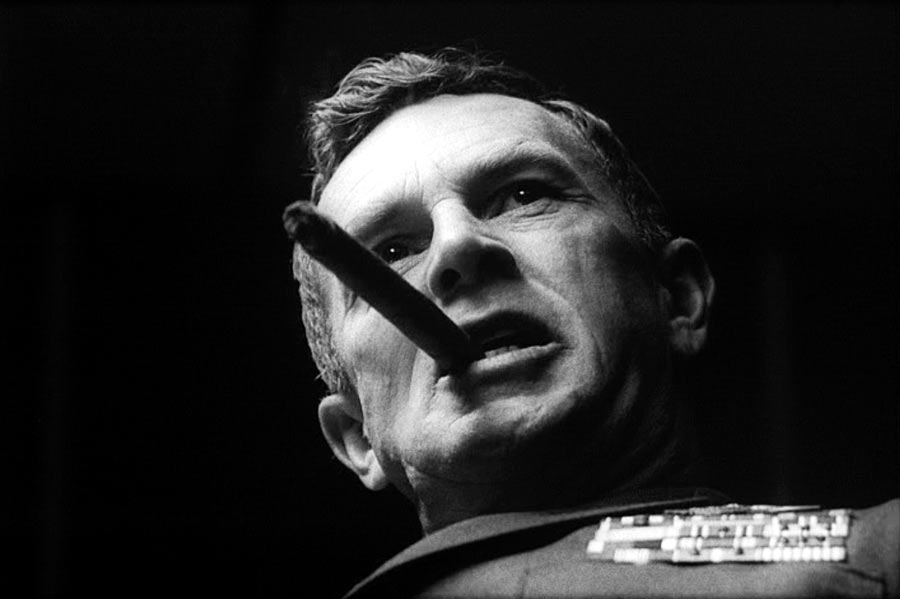
Werth: A director that many consider to be a good candidate for auteur status is Stanley Kubrick. Throughout a wide range of film genres, Kubrick's films have a distinct visual style and viewpoint that make his work unmistakeable. One of his most popular films is 1964's long-titled Dr. Strangelove: Or How I Learned to Stop Worrying and Love the Bomb. Originally conceived as a thriller based on Peter George's Red Alert, Kubrick's re-writes of the script kept getting funnier and funnier. So he decided that the best way to communicate his dark theme of nuclear detente was through satire, and, with writer Terry Southern's help, he soon had a hilarious dark comedy script to shoot.

Wise: I wonder if Battleship began as a thoughtful examination of nuclear responsibility? 

Werth: A crazed general trips an alarm sending U.S. bombers to drop nukes on Russia starting a domino effect that insures the destruction of both countries and the world. Now just reading the plot, it's hard to find anything funny about it, but all one has to do is look at some of the character names to know that this movie has a wicked sense of humor.
Peter Sellers masterfully improvises three characters: Group Captain Lionel Mandrake, President Merkin Muffley and the ex-Nazi scientist Dr. Strangelove. George C. Scott chews up the scenery in the War Room as gum-chewing General Buck Turgidson. Sterling Hayden is the body fluid-obsessed commander of Burpelson Airbase, General Jack Ripper. Slim Pickens drawls his way onto a nuclear warhead as Major '"King" Kong. But Keenan Wynn really tips the comedy name scales as Colonel "Bat" Guano.

Wise: Clearly Kubrick should not name children.

Werth: Kubrick's genius with his dramatic material (like Full Metal Jacket (1987) and A Clockwork Orange (1971)) was to wrap his real world themes in dark, ridiculous comedy. He worked this idea of overlapping real and unreal into how he shot his films as well. The opening scene is visual poetry with the credits appearing over stock footage of a mid-air plane re-fueling that winds up looking like plane sex to the tune of "Try a Little Tenderness."
Fantastical sets like the War Room are shot under high, focused, overhead lighting to give a sense of realism (much like his use of candlelight in Barry Lyndon (1975)).
His use of handheld cameras for the assault on Burpelson gives a documentary style to the action, but his very long takes and static, often dramatic, camera angles for other scenes create a striking cinematic effect (much like his long tracking shots using a Steadicam in The Shining (1981) and Eyes Wide Shut (1999)).
His attention to details like cockpit checklists and phone conversations is so precise in its grasp of reality, that it makes a viewer wonder why the "boring stuff" wasn't cut-out of the movie.
That dual quality of being aware and at the same time not aware that you are watching a movie is a cohesive theme that resonates through all of Kubrick's films, making him an arguable example of the visual and thematic auteur director.

Wise: I wonder if Truffaut would think Film Gab was an auteur blog.

Werth: Tune in to Film Gab next week when we use a Ouija board and a French phrasebook to find out!


Thursday, August 2, 2012

Hunks, Hogs and Hot Ladies

Just a quick reminder to all the classic film lovers out there that this weekend Film Forum continues its celebration of Universal Studios.  Forget the beach and curl up with some of these treasures from the Universal vault:

Indulge in soapy romance with two Douglas Sirk classics (both starring delectable Rock Hudson) with Written on the Wind (1956) and Magnificent Obsession (1954).  
 
Enjoy a double date with two of Hollywood's most iconic leading ladies—Audrey Hepburn and Doris Day—when the Forum presents Charade (1963) and Pillow Talk (1959).  


Or, skip brunch and spend the afternoon with the cuddliest pork belly (sorry, Miss Piggy) to ever hit the silver screen: Babe (1995).  While this heroic ham doesn't come with a complimentary mimosa, this little piggy does star in an even more audacious and adorable sequel Babe: Pig in the City (1998), which, unfortunately, is not part of Film Forum's line-up, but is available for you to complete a porcine film festival at home.